

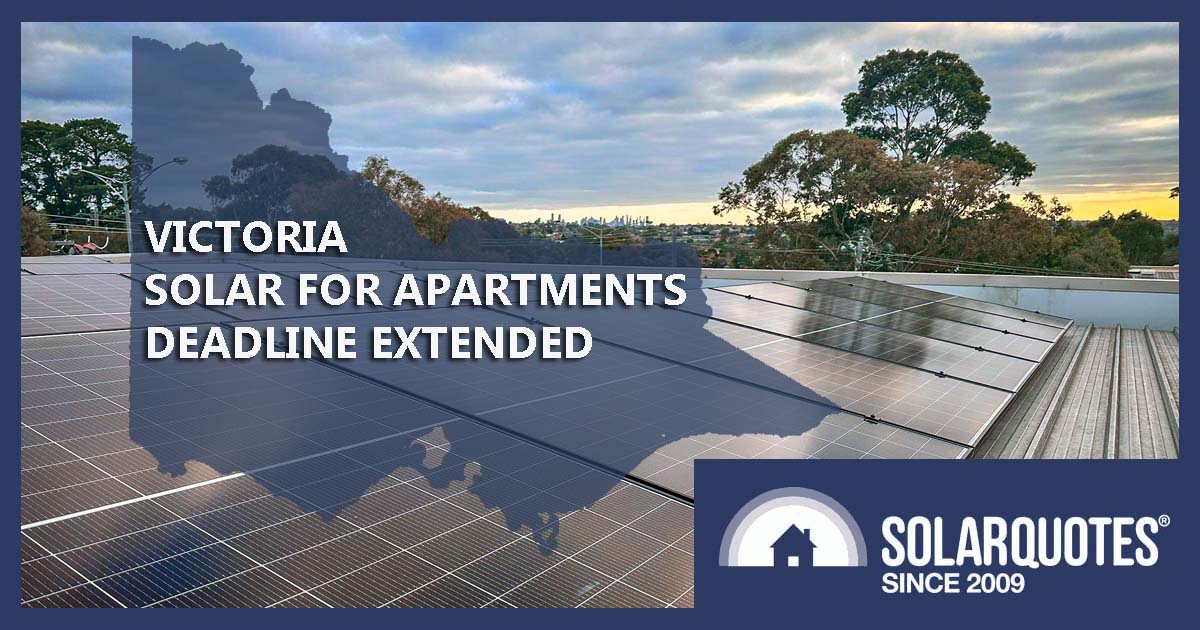

Victoria has extended its Solar for Homes program until June 30, 2027, giving residents of apartments and strata buildings more time to use rooftop solar panels and reduce electricity bills.
Initial uptake has been robust, and a new case study shows that residential solar is now moving from policy to real-world installation and the savings are reaching residents.
When does Victoria’s Solar for Apartments program end?
The Victorian Government has confirmed that its Solar for Apartments program – originally scheduled to end on April 30, 2026 – will now run until mid-2027.
The extension reflects steady demand since the program launched in early 2024. More than $5.7 million has already been paid out for 141 apartment buildings with over 2,650 apartments. Although this proportion is growing, it still represents a small proportion of Victoria’s housing stock.
Under the program, eligible multifamily properties can access rebates of up to $2,800 per apartment, capped at $140,000 per complex. The program is expected to result in savings of up to $500 per year on household electricity bills.
“We’ve seen a lot of interest from apartment dwellers – that’s why we’ve extended applications for the program to give more Victorians the opportunity to switch to solar energy and reduce their electricity bills,” Solar Victoria CEO Stan Krpan said.
From politics to practical reality
A recent installation in Templestowe, north-east Melbourne, shows what residential solar panels will look like when they are actually built.
The project, undertaken by Solahart Eastern Ranges, involved 27 homeowners opting into the rebate program and another 12 households joining a separate shared solar system.
Installation is underway at the Templestowe apartment complex, where rooftop solar panels are being installed as part of Victoria’s Solar for Apartments program.
The rebates reduced upfront installation costs by $75,600 in all participating units. In housing projects like this, the biggest hurdle is often not the technology, but the coordinating agreement between multiple owners.
It is now predicted that residents can save between $320 and $640 per year on electricity bills, based on small systems per apartment with outputs of about 1 kW to just under 2 kW.
This reflects the reality of shared rooftops, where the available space must be divided between multiple apartments.
The system leverages Enphase microinverter technology, which enables module-level optimization and individual monitoring, with apartment allocation varying between two, three and four modules per apartment depending on participation.
Still not an easy rollout
The Templestowe project highlights how much more complex solar installations in apartments are compared to solar installations on the roofs of single-family homes.
Strata approval processes, shared incentives between owners and tenants, and site-specific restrictions add additional friction. Even if the economics are right, getting enough owners to agree on the system design can still be the hardest part of the job.
As a result, demand is increasing but remains relatively low compared to the single-family home market.
Why extension is important
The extension until 2027 signals that the government sees both progress and unfinished business.
On the one hand, thousands of homes now benefit from solar energy in ways that simply weren’t practical a few years ago. On the other hand, the numbers are still modest for a state with so much multifamily housing stock.
In other words: the model works, but is not yet scaled. And scaling residential solar power will never happen as quickly as it does for single-family homes. Every building is a confrontation between technology, governance and human behavior.
The long way to a residential solar system
Residential solar energy is still in its early stages in Australia compared to rooftop solar energy. While programs like Solar for Apartments are helping to unlock the sector, progress remains slow and uneven.
At the moment it is a gradual change rather than a rapid change. Just don’t expect residential solar to behave like the residential solar boom that came before it.
Would you like to find out how solar energy works for homes and whether your building is suitable for it? For more information, see SolarQuotes’ apartment solar guide.

Comments are closed.