


Most solar owners evaluate their system based on one simple measure: how much energy it produces throughout the day. If the whole thing looks good, it was a good day. If it doesn’t work, there must be something wrong – but that’s not always the whole truth.
To understand why, it’s helpful to look at how solar energy actually behaves in real time – something solar forecasters are tracking closely.
Why does solar output fluctuate so much?
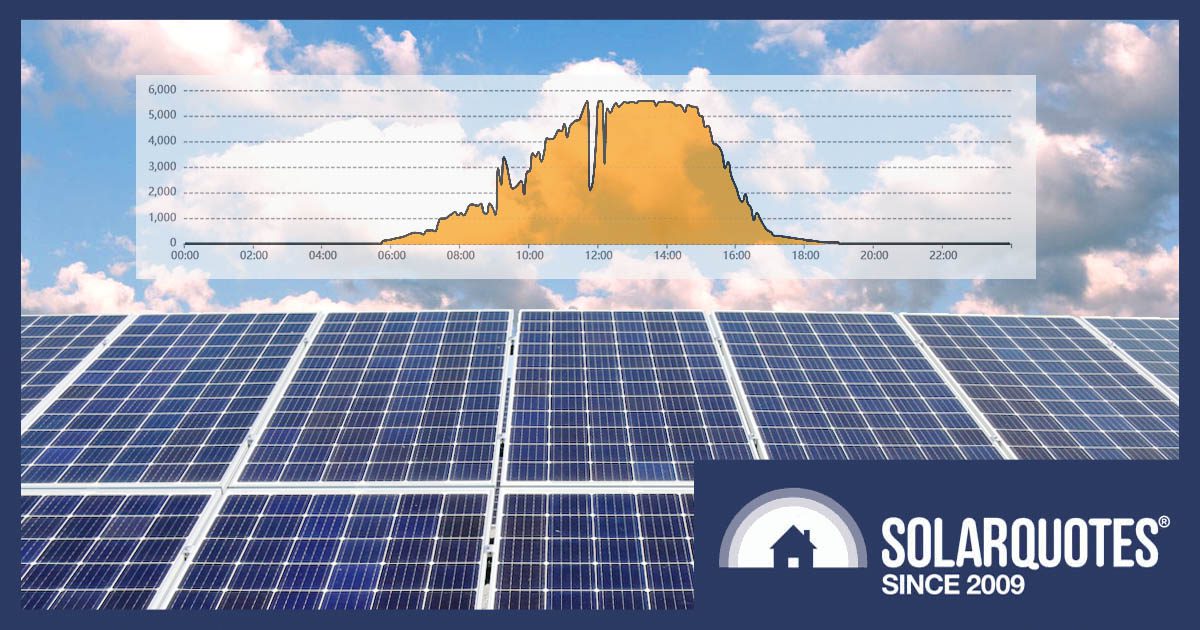
If you’ve ever checked your monitoring app and wondered why your solar output rises and falls on an otherwise good day, you’ll see something very common: output can rise and fall sharply, with dips and recoveries that don’t always follow a consistent pattern.
Even on stable days, solar output rarely moves in a consistent line. These fluctuations are easy to see in the output graph, but not in the way most people interpret performance.
On a typical “good” day, solar output can still experience short, sharp dips – even if overall generation remains strong.
Daily totals compared to real-time solar behavior
Time of day and season are the predictable part of solar radiation. What changes in real time is the way that signal is shaped by the atmosphere, particularly cloud cover.
This variability is what solar forecasting systems are designed to model. Companies like Solstice AI and Solcast use this modeling to track how production changes from minute to minute, not just what the total looks like at the end of the day.
That’s why forecasting systems focus on questions like: what happens at 10:17 a.m. when a cloud passes, how quickly production drops and recovers, and how accurate a five-minute forecast really is.
Forecasters use this information to make network and market decisions in real time. At the household level, the same fluctuations in performance manifest themselves in smaller but still significant ways – particularly when energy is consumed, stored or sourced from the grid.
The cloud problem behind solar variability
“Predicting the performance of rooftop solar PV systems is inherently complex as it depends on both atmospheric conditions and site-specific factors,” says Dr. Julian de Hoog from Solstice AI.
The challenge begins with estimating how much solar radiation reaches a given location. While times of day and season are predictable, cloud behavior accounts for most of the uncertainty in short-term forecasts.
Days with consistent conditions – either clear skies or dense clouds – are easier to predict. Intermittent clouds, especially small, fast-moving “spot clouds,” are much more difficult. These may be too small to be resolved in satellite images, but still cause large fluctuations in solar energy production.
A passing cloud cover can cause brief, sharp changes in solar output even when conditions appear stable.
At this time of year, additional factors can complicate the forecast. In northern Australia, convective cloud formation may remain active into the autumn, with clouds developing quickly and without warning. Morning fog is more common in southern regions and can affect predictability at the start of the day.
From a forecasting perspective, this makes short-term production difficult to predict, while at the household level it can still look like a normal sunny day.
When timing matters at home
Until recently, short-term changes in solar output were not a major concern for most households. When the daily total was strong, short dips throughout the day were not particularly important.
But that’s starting to change as more households use solar energy in real time and not just as a way to offset bills. Falling feed-in tariffs as well as the increase in electric vehicles, batteries and usage-based prices are shifting the focus from energy export to the use of the energy produced.
Charging electric vehicles during the day, powering devices directly from solar energy, storing excess in batteries and avoiding grid imports during peak prices make timing more important than before.
In some cases, such as demand-based tariffs, a brief spike in grid usage during a decline in solar output can have a far greater impact on costs than you might expect because charges are based on peak demand rather than total energy.
While a passing cloud barely changes the daily total, it can still cause production to drop at exactly the wrong moment – triggering unexpected grid imports.
A short-term drop in solar output can trigger an immediate increase in grid usage.
Should solar owners think like forecasters?
Not really – but it helps to understand the difference between real-time changes and daily totals.
Forecasters focus on accuracy over time because their results inform grid operations and market decisions on a large scale. Solar owners focus on results over the course of a day, with small fluctuations usually not having a large financial impact.
But as more households rely on solar energy in real time, this gap will shrink. Because once you start harnessing solar energy when it’s created, rather than just what it produces when the sun goes down, short-term changes become more important.
Timing is important
It’s not about choosing between daily totals and real-time behavior – it’s about understanding both. For most households, the daily total will still be the main number. That hasn’t changed.
As devices, batteries and electric vehicles are increasingly tied to the availability of solar energy, short-term fluctuations are playing a role in practice that did not exist before.
This doesn’t mean tracking every decline or watching every cloud. It’s just a matter of having a rough sense of when your solar system is working well – and matching the majority of your energy consumption to the periods when this is possible. Installing a home battery storage system can also help you weather short-term downturns without being dependent on the grid.
For a deeper breakdown of how solar, power, and energy fit together, our energy vs. power (kW vs. kWh) guide is a good place to start.

Comments are closed.