

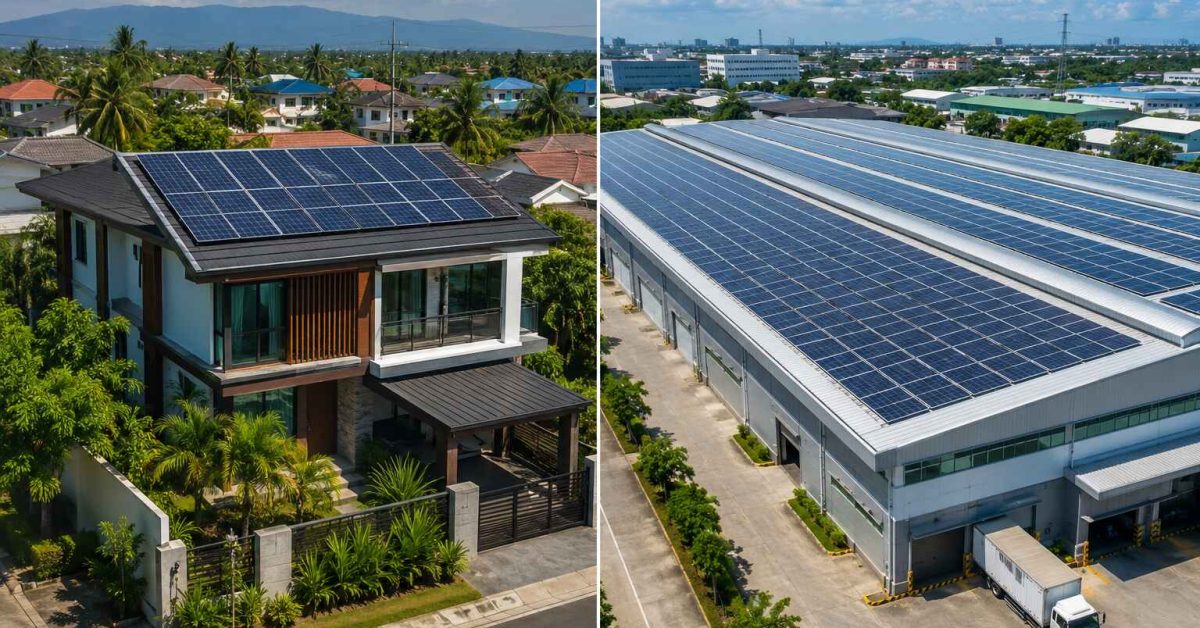

overview
- Residential and commercial solar systems are designed to meet different energy needs, installation requirements and financial goals.
- Residential solar systems are smaller and focus on reducing household electricity costs, while commercial systems are designed for higher energy consumption and long-term operational savings.
- Understanding these differences helps real estate developers improve energy efficiency, support sustainability goals and increase property value.
From the outside, solar panels may look similar, but the way they are designed for residential and commercial properties can be very different. A single-family home may need a system to support air conditioning, refrigerators, lighting, and appliances. A commercial building, on the other hand, may require a larger system to support office equipment, cooling systems, machinery, lighting, and daily business operations.
It is important for real estate developers offering eco-friendly homes to understand this difference. It will help you decide whether a project requires a residential solar system, a commercial solar system or solar-ready planning for future expansion. Solaric offers both Solar energy for houses And commercial solar panel systems for real estate in the Philippines.
System size and energy requirements
The biggest difference is the system size. Residential complexes are usually designed to accommodate monthly household electricity consumption. Solaric recommends a rough guide 1 kWp solar modules per 100-130 kWh monthly electricity consumptionthat helps homeowners estimate the correct system size based on actual usage.
Home systems can support appliances such as refrigerators, lamps, fans, computers, washing machines, and daytime air conditioners. Solaric’s home solutions Reduce grid dependency and support household savings.
Commercial buildings generally require a significantly larger system because their energy requirements are higher. Offices, shopping malls, warehouses, hotels, factories and schools often use a lot of electricity during the day. Solaric’s commercial solar panel systems are designed for facilities such as offices, factories and schools to reduce operating costs and support the use of clean energy.
Design and installation differences
Both private and commercial solar power systems use modules, inverters, mounting systems, cabling and security components. However, the design process for commercial buildings becomes more complex.
Residential solar design
For houses, planning usually focuses on the available roof space, roofing material, shading and monthly electricity consumption. 1 kWp solar modules can be accommodated on around 4 square meters of usable roof area. This will help homeowners determine whether their roof can support the size system they desire.
Residential roofs can be made of GI panels, tiles, concrete, or other materials. The installer must check this Roof conditionSlope, shading and mounting compatibility before installation.
Commercial solar design
Commercial solar systems are designed to meet the larger and more complex energy needs of offices, warehouses, schools, shopping centers and factories.
Effective system design begins with understanding the building’s energy consumption to properly match solar panels, inverters and electrical components to operational needs.
For real estate developers, early planning of roof layout, structural support, electrical routes and maintenance access helps ensure better performance, safety and long-term reliability.
Capacity and equipment considerations
Residential solar power systems often use an inverter or a simpler setup. Commercial solar power systems may use multiple inverters, larger arrays, or more advanced monitoring, depending on the size of the project.
Panel quality is important for both types of property. Solaric offers IEC specification or Solaric-Strong devices that are tested for durability, reliability and affordability. This is important for both homes and businesses because solar energy is a long-term investment.
Cost and return on investment
The focus of residential solar systems is on reducing monthly household electricity bills, while commercial solar systems aim to reduce operating costs, improve long-term cash flow and support sustainability goals.
In the Philippines, where Electricity tariffs average PHP 10-14 per kWh, solar energy is particularly valuable for businesses with high energy consumption per day.
For real estate developers, residential solar increases the appeal of green homes, while commercial solar increases the value of offices, retail spaces and mixed-use buildings by attracting cost-conscious and sustainability-focused tenants.
Maintenance and long-term performance
Both private and commercial solar power systems must be cleaned, monitored and checked regularly. Rooftop solar panel systems require minimal maintenance, typically occasional cleaning and performance checks, to maintain energy production.
The difference is in the scale. A homeowner may only need occasional panel cleaning and basic monitoring. A commercial property may require scheduled inspections, performance reports, and more structured maintenance as a larger system impacts business operations.
Solar panels can last a long time 25 years and moreThat’s why proper installation and maintenance is important from the start.
Choose the right solar system for your property
Residential solar systems are typically ideal for single-family homes and green developments, with sizing based on the household’s energy use, available roof space and future energy needs.
Commercial solar systems are more suitable for offices, warehouses, schools, factories, shopping malls, hotels and mixed-use buildings that require higher daily energy capacity and long-term operational savings.
For real estate developers, planning projects that are solar-ready from the start can provide long-term value. This includes planning roof alignment, structural support, electrical wiring and inverter allocation during construction.
Key to take away
The Difference of solar panels between commercial and residential buildings depends on system size, energy requirements, design complexity, installation planning and financial goals.
Residential solar energy helps reduce electricity costs for households, while commercial solar energy enables lower operating costs and improved energy efficiency for businesses.
Solaric offers customized residential and commercial solar solutions based on your property type and energy goals. Request a free solar quote today.

Comments are closed.