

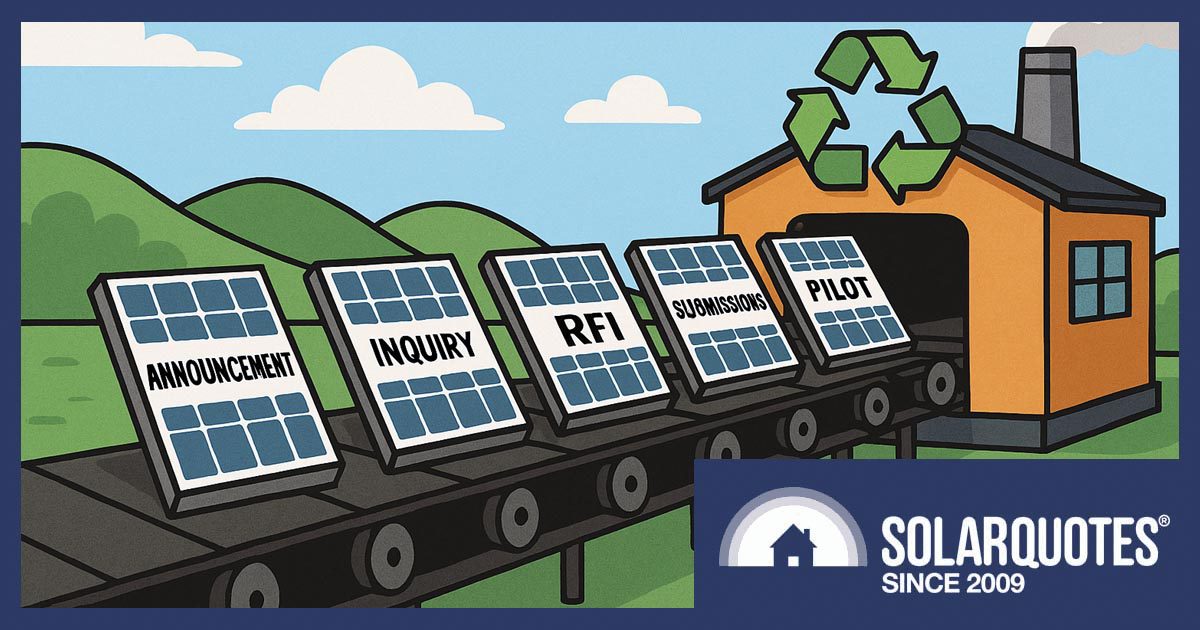

Following the announcement of a national pilot project to recycle solar panels, a parliamentary inquiry has now been launched, along with formal requests for industry and public involvement – a sign that things are finally turning around. We spoke to recyclers to get their perspective.
What is the national solar panel recycling pilot project?
The pilot project itself was announced earlier this year and supported with federal funding to test how discarded solar panels can be collected and recycled on a large scale. The government has since issued a request for information (RFI) to industry seeking practical suggestions on how a national pilot would work, while the parliamentary inquiry has opened the door to submissions from industry, experts and the public.
According to the Ministry of Climate Change, Energy, Environment and Water, the pilot project is expected to move into an open procurement phase later this year, with an administrator appointed to manage the program.
The pilot project is scheduled to begin in mid-2026 and will test collection and recycling routes at around 100 locations across the country. Its purpose is to gather real-world data on logistics, costs and recovery outcomes and use that evidence to inform what comes next – including any future national stewardship programs.
Challenges in recycling solar modules on site
To understand what the system has to deal with, it is helpful to take a look at what is happening on the ground. Recyclers operating in Australia today describe a sector that is technically capable but structurally limited.
Anthony Vippone, CEO of Lotus Recycling, points to the lack of consistent standards and oversight across the industry. Without clear definitions and responsibilities, it’s difficult to know what happens to panels when they leave a website.
“The (national) standards for solar panel recycling are zero. AS/NZS577 (E-Waste Management Systems Certification) doesn’t even mention solar panel recycling requirements, recovery rates or reporting requirements,” he says.
The lack of a clear recycling standard and control system means that panels can end up in landfill, stored or exported illegally. In some cases, the public’s goodwill is being exploited by some questionable recycling companies offering to recycle panels, but they end up in landfill or buried in a farmer’s paddock without responsibility.
“We need accountability – big fines for corporate executives who mislead the public,” Anthony adds.
“With regard to the future pilot program, an analogy would be: it would be pointless to introduce speed limits on roads if there were no penalties for violating them.”
Local recyclers are being undermined by offshore exports
James Petesic, founder of solar panel recycling plant PV Industries, agrees that operators exploiting the current compliance gap are undermining the economic viability of reputable companies trying to do the right thing.
“The biggest obstacle to our industry is the illegal offshore export practice. This means we lose raw materials. The biggest factor that determines the profitability of a recycling company is throughput. If we lose up to 80 or 90 percent of the modules that are decommissioned, that is a massive handbrake for our entire industry.”
“The best way to counteract these illegal practices, rather than better police them, is to increase the cost of the solar panels (going to a recycling facility). So instead of getting the installer X amount and offloading it to a shady operator (at the cheapest price), they should be incentivized to have them properly recycled.”
Feasibility aside, James says the economics of disposing of a solar panel in a landfill versus a recycling facility is no longer the biggest sticking point it once was.
“Over time, solar panel recycling has improved and is now comparable (economically) to sending them to a landfill. We have become better at recovering more solar panels and increasing the value of the materials in the end,” he says.
Industry input shapes the pilot project
In conclusion, Vippone and Petesic highlight some of the gaps that have held the industry back: unclear standards, lack of oversight and difficulties in getting panels to recycling facilities. Their findings illustrate the very issues on which the government is now inviting industry, experts and the public to comment as part of the parliamentary inquiry and the RFI.
Share your opinion
The request is open to anyone – industry participants, researchers, environmental groups or concerned members of the public – and the deadline for submission is March 27.
In the meantime, the government’s Request for Information (RFI) is seeking input from industry specifically on how the national pilot will work. Answers must be submitted by March 3rd.
For potential stakeholders: If you hurry, there will be an industry briefing on the RFI on Monday 16 February at 2pm AEDT. e-mail [email protected] for a meeting invitation.
Contributions to both processes could help shape the design of the pilot and influence future national policy.
Looking ahead
Australia’s solar panel recycling sector is still finding its footing, but for the first time there is a clear path for bringing together real data, practical feedback and possible reforms. For those who want to follow the industry or influence its future, the investigation and RFI offer a chance to move beyond talk—and toward a system that actually works.
In the meantime, perhaps the best thing you can do to reduce solar installation waste is to buy panels that last a long time – the good news is that most old solar panels appear to be living up to their warranty promises, although other new research has found that a significant minority of panels are degrading faster than expected.

Comments are closed.