


With fire season in full swing, it’s worth thinking about what you can do to maintain your home, even if rooftop solar makes things a little difficult.
Clearing gutters is a never-ending task, but the question that has always bothered me is: Why can’t anyone offer a self-cleaning solution that actually works?
How does solar energy affect roof maintenance?
If you’re planning a major overhaul of your home – such as replacing the roof and upgrading the insulation before installing a solar system – keep in mind that the new glass on the roof can hinder roof maintenance work that’s important for fire safety, as I explained last week.
One of the most important tasks on the roof is cleaning the gutters.
As a kid, I was often the lead gutter cleaner at home, and as a roofer, I’ve seen a dozen different approaches to supposedly reduce maintenance.
The answer is surely a mix of tradition and aesthetics, mixed with an unhealthy dose of what the neighbors will think!?
Here’s the thing: Unless the neighbors offer to clean your gutters regularly, you don’t have to worry about what they think. Especially during fire season, it is even more important that the site is well maintained.
Read on as we introduce you to the best solution to reduce your fire risk and extend the life of your gutters.
Standard practice is liability
For those who have reviewed the building code, there is information about gutter size, overflow slots, and fall rates. There are also calculations of the number and size of downpipes for a specific roof area.
There are also cross-sectional diagrams which show that your roofing needs to extend into the gutter by at least 50mm. This is considered essential to ensure that rain runs off the tarp and does not run back down the bottom, fascia or anywhere else it shouldn’t go.
Garden gutter installation with various garden waste decomposing into wet sludge. The blue arrow shows the panel fairly deep behind the outer edge.
However, once you’re in Darwin, none of this is possible. They don’t bother because in the rainy season, gutters are about as useful as trying to catch a flood with a paper cup.
Darwinists are pretty laid back, so no one bats an eyelid when the wavy edge of a roof is visible.
Screening of ideas
Gutters are a curse because they channel more leaves than water. And gutter guards of various types aren’t much better.
There are many novelty products such as cover sheets, screens or oversized bottle brushes, and they are all based on the idea of preserving the leaves out of the gutters tend to dry out and then blow away.
However, I would never think about conventional solutions that you buy and retrofit. My best fellow carpenter will go on for a long time about how much he hates them, and he dealt with them for a living when he installed pergolas.
Years ago I did this experiment on a low garden shed. It worked, but the crude net had holes that were the perfect size to catch rubber nuts.
There are plastic screens that crack and fall apart, hundreds of holes with brackets held in place by tiny screws, edges that catch pine needles and leaves, metal screens that actually prevent you from cleaning the gutter.
Imagine trying to drain your spaghetti by pouring it onto an inverted colander. An aftermarket gate that screws onto the outside of the house is just as silly.
This roof was a few months old and even though there was a gutter net screwed on top, pine needles were already collecting when we had to temporarily remove part of it to install a solar system.
The only commercially available systems that are worth it in my opinion are the systems installed on a tiled roof that reach under the first row of tiles and are grouted under the ridges. However, it is an expensive job and tiles are a hideous thing anyway.
Put your gutter on autopilot
The key to getting your gutters to clean themselves is to:
Place the net under the paneling.
Hang the gutters lower than usual.
The concepts aren’t rocket science, but if you’re hiring a contractor to do the work, you’ll probably need to make the point more than once (or show them this article).
The proof is in the pudding
I’ve done the experiment in a few places, but none show the results more clearly than two identical sheds built two years and three feet apart.
This gutter has a little dirt and dust, but is not full of mud that causes rust.
The gutters on this newer shed are full of wet leaves, but from the ground it looks fine
There was nothing special or difficult about this installation. The stainless grill came from the hardware store and everything else was just standard shed hardware, although external gutter brackets would provide a better solution.
The only real change is that the gutters are set slightly lower than normal. While some pedants may argue that the leaves are not IN the gutter, raising it to the traditional height would just create a deep edge for collecting leaves.
This could actually have been lower to improve self-cleaning, but either way it prevents large amounts of rubbish from accumulating In the gutter.
By lowering the gutter, there is less risk of leaves and branches getting caught on the edge. However, a smaller amount is collected and is easier to move with a garden blower or broom. What is not blown away dries out. You no longer have a compost mat that rusts the gutter and causes weeds to grow in front of your rainwater tank.
The only compromise is that you will be more likely to see the wrinkled edge of the roof – depending on the height of course.
Do not accept substitutions
When it comes to construction work, you have to be aware that the industry is quite conservative, and not necessarily in a good way. Builders are good at saving effort and profit. They like doing what they know, and new ideas, however good, present a challenge to that tradition.
Of course, there are good reasons to stick with knitting – in some cases, standard building products like metal siding and internal gutter brackets don’t allow for much variation in dimensions. We also have tons of rules that explain how things should be done and hopefully prevent cutting corners and poor work.
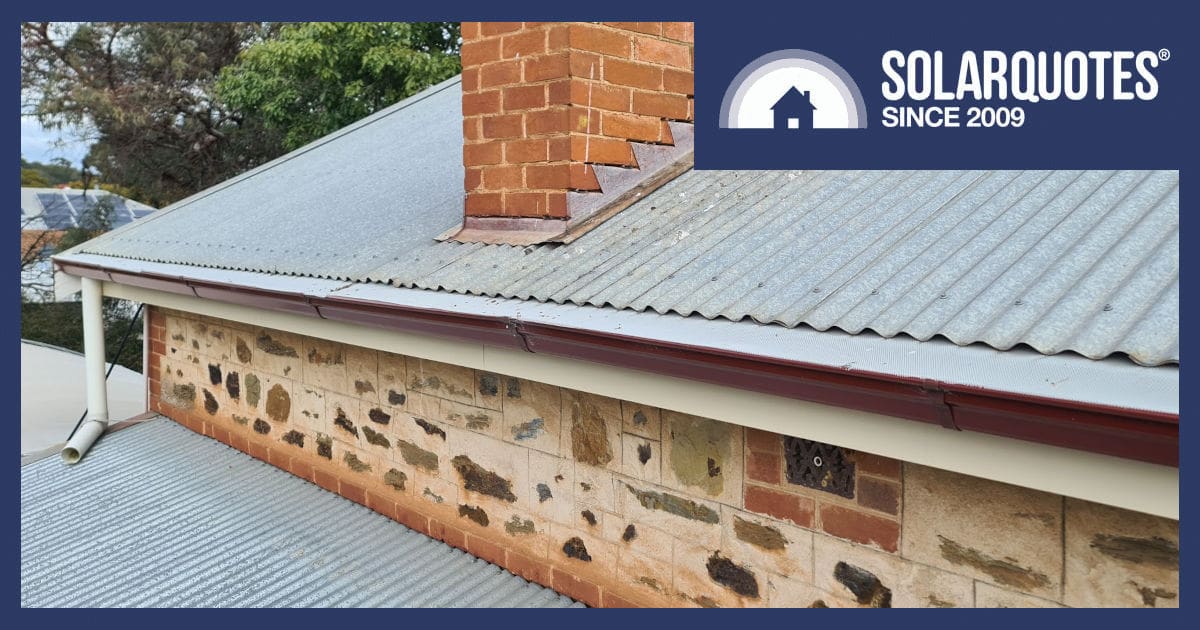
In fact, the picture below shows a cut off roof. Since there was hardly any overhang, water dripping from the sheets would blow back, run down behind the gutter, and drip off the fascia. Without the cost of re-roofing, it offered the opportunity to turn a sow’s ear into a silk handbag.
This aluminum gutter grille has been around for years. It just works.
First I found a supplier of gutter nets and after explaining to him what I was doing, I convinced him to sell me a whole 1 meter wide roll of aluminum nets. I was surprised to see that they cut it with a Stanley knife, but I prefer roofing shears.
The standard kits they sold included 200mm wide mesh as well as clips, screws and angle plates. With the whole roll I had four times more material for the same price per meter and the ability to cut strips in the widths and lengths I needed.
The process looked like this:
- The old gutter was removed and the wooden facade was repaired where necessary.
- The panel is covered with a simple J-shaped metal surround panel in a durable color bond, saving hours of sanding and painting.
- New external gutter brackets are installed approximately 40mm lower than the old ones (you may need to paint these accordingly).
- New gutters installed and connected.
- Unique new flashing installed as a flange that extends under the roofing sheets and down into the gutter (this means the short roofing sheets would definitely extend into the gutter).
- Finally, the aluminum fabric, cut into 200 mm wide strips, was pulled under the roof sheets and positioned.
- The bottom row of screws was reinstalled to secure the sheets and mesh.
Solar is part of a suite
Whether you’re simply looking for some relief on your energy bills or are planning to renovate your permanent home sustainably, it’s worth thinking about what you’ll need if the hot water supply goes out, the furnace breaks down or the roof leaks.
With a little planning you can achieve the best results. Since falls disproportionately affect the elderly homeowner, anything that keeps you off the ladder is a good thing.
This is the latest in our series on solar power and bushfires – read our stories about why you need to maintain a solar system in areas at high risk of bushfires and what you should actually do with your solar system and battery if you have to evacuate.

Comments are closed.