

Summer started slowly for me, but now it’s hard to miss, and with it come the emergency warnings of bushfires, extreme heat and flooding.
So what special precautions should you take with your solar and battery systems?
Should you turn off the solar system during a bushfire evacuation?
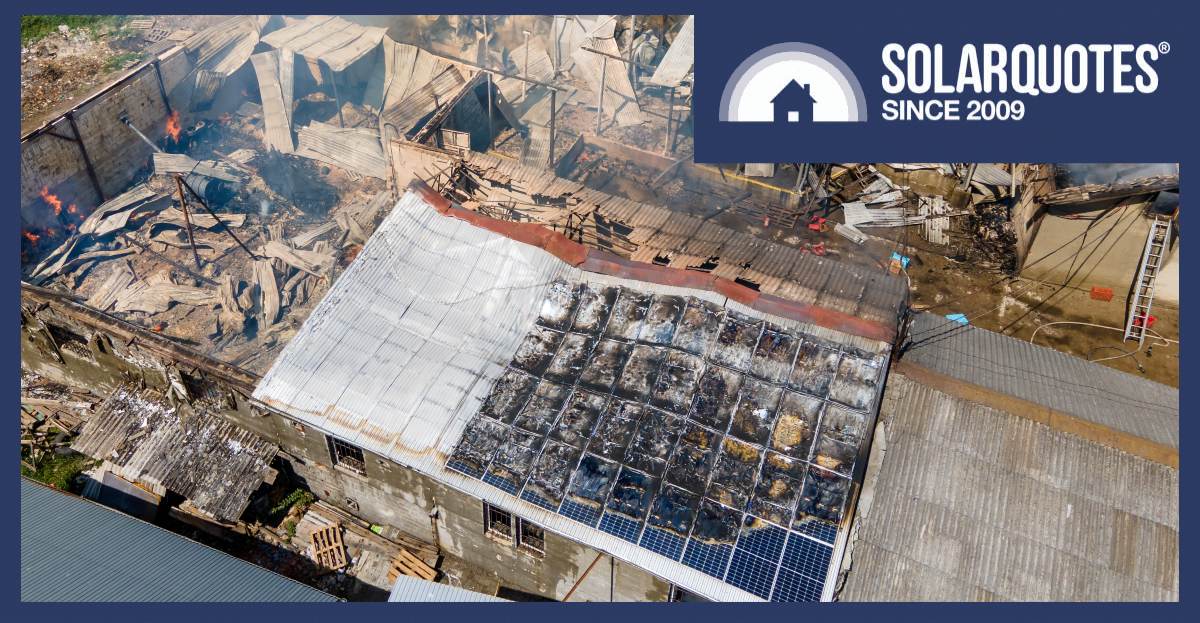
As bushfires rage across the state, authorities in Victoria have warned people that in the event of an evacuation they should turn off everything on the main electrical panel and turn off their solar array, including all battery systems.
I assume they are trying to make it very easy for everyone involved. When distribution authorities shut off power to the entire district, they are trying to keep everyone safe and prevent the power lines from starting a fire. This allows firefighters to fight a building fire with the confidence that there is no power.
If you don’t care about the contents of the freezer, just turn everything off at the main electrical panel. However, it seems a bit counterproductive to me to turn off the power when you’ve invested in an expensive battery to keep it running.
Some people actually rely on their battery system to power fire pumps, internet, and security measures. Although you would need a very powerful system, electric pumps are far more reliable and easier to start remotely than a gasoline or diesel pump.
My advice is to consider your individual situation. No one wants people to get hurt when responding to an emergency, but that might mean turning off the power and leaving outside lights on to guide the way for those trying to put out a fire or seek shelter.
A warning from Energy Safe Victoria shared on social media.
What if you don’t evacuate?
You may want to disconnect your battery system from a potentially unstable grid in an emergency. However, by doing so, you are denying yourself the grid support that your solar grid may well need.
Be sure to keep your usage under control and remember that on the second or third day of a prolonged emergency, the grid may become the backup generator you need.
Taken together, each solar power system helps reduce overall demand by around 15-18%. It helps make the entire network more reliable, and without it, the wheels could well fall off.
In the past there have been repeated incidents in which network operators called for solar power to be switched off. However, these were technical emergencies in which too much of a good thing made life difficult for the network.
The situation is different for most natural disasters. During Cyclone Alfred last year, Energy Queensland told people to turn off solar power for no good reason. They just caused confusion, especially for people who had invested in a battery backup. They didn’t give the same advice to people who had connected a backup generator.
One important thing to remember about bushfires is that they can effectively turn day into night, meaning your solar array can be rendered pretty useless by thick clouds of smoke or even heavy cloud cover that follows a tropical storm or cyclone.
An abundance of caution
If you have a standard solar system connected to the grid, it will automatically turn off when the authorities turn off the power. The only good reason to shut down the system yourself is to prevent a grid fault from damaging your inverter.
It’s possible that a falling tree branch could short out the transmission to the distribution lines, and if that happens, 11,000 volts will likely destroy everything in the house. So if you’re risk-averse, you can turn off your inverter (and everything else in the main panel) to protect it.
Batteries are beautiful
If you are lucky enough to have a battery, the first thing you should do is make sure the installation has been set up properly to protect you from failures.
Testing should be as simple as turning off the “Main Switch Normal Supply” (or on older installations it could be “Main Isolator Grid Supply”) and noticing that the lights stay on (or come back in 15 seconds).
Turn off the RED switch to disconnect from power. In 2024, “alternative” is the technical jargon for electricity from a battery system.
Your electrician should have explained this to you when handing over the documentation at the end of the installation. If not, call and get the service you paid for.
If there is an emergency
The second option is to charge the battery 100% from the mains. Systems like Tesla are automated and call this feature “Stormwatch,” but many require you to intervene via the monitoring app when changing settings.
This is particularly important if you have a virtual power plant that exercises external control. Nobody cares much about making $2 on the wholesale electricity market during a fire or flood.
Summer makes energy interesting
For years, Australia’s energy systems have been put under the greatest strain during the height of summer, due to the cooling and increasing air conditioning of poorly built, poorly designed and oversized homes.
Whether it’s the generation plants, boilers, turbines, generators, pumps and associated systems or the distribution, transformers, switchgear, power lines and connections – everything is more susceptible to failure in high summer heat.
And it’s not just the ambient heat, but also electrical heat from inside due to high current loads. I’ve seen cases where power grid office workers were literally dragged to substations, given a lawn chair, a hat, and a hose, and told to spray water on overloaded transformers to tide them over the afternoon.
Tingling faucets can be fatal
Be aware
If your home’s power supply has a bad connection (sometimes called a loose neutral), everything in the house can be connected to the ground circuit live. The metal casing of a device can give you a shock.
- This can happen if a branch falls and destroys an overhead line or if there is simply overheating of the connection.
- RCD safety switches do not work.
If your faucets or appliances feel a tickling, tingling or shaking sensation,
Go back and call your local network provider.
- Do not open the metal electrical panel.
- The people with poles and wires will send a truck faster than you can hang up the phone
- They will diagnose for free, and if there is a problem on their side of the supply, they will fix it for free too.
- Although it’s rare, it happened at my house this week and that’s it extremely dangerous.
Solar is the good news
I am reliably informed that we have recorded exceptionally high demand on the national electricity market in recent days. When including behind-the-meter output, we saw the first, third and fourth highest demand days on record during the January 7-10 heat wave that the NEM covered.
Fortunately, rooftop solar panels managed to carry much of the load during this time of high demand, helping to keep the power grid running without the problems it previously had on hot summer days.
Green and gold represent wind and solar, but the novelty this year is the appearance of dark blue batteries that will devour the gas generators at tea time.
While firefighters will curse the winds for getting away with the cool change, wind generation is of course a huge success. That means when temperatures drop in Adelaide, the turbines in South Australia’s mid-north turn to provide cheap energy across the country.
For more information, see my recent article on protecting home batteries from extreme heat.

Comments are closed.