

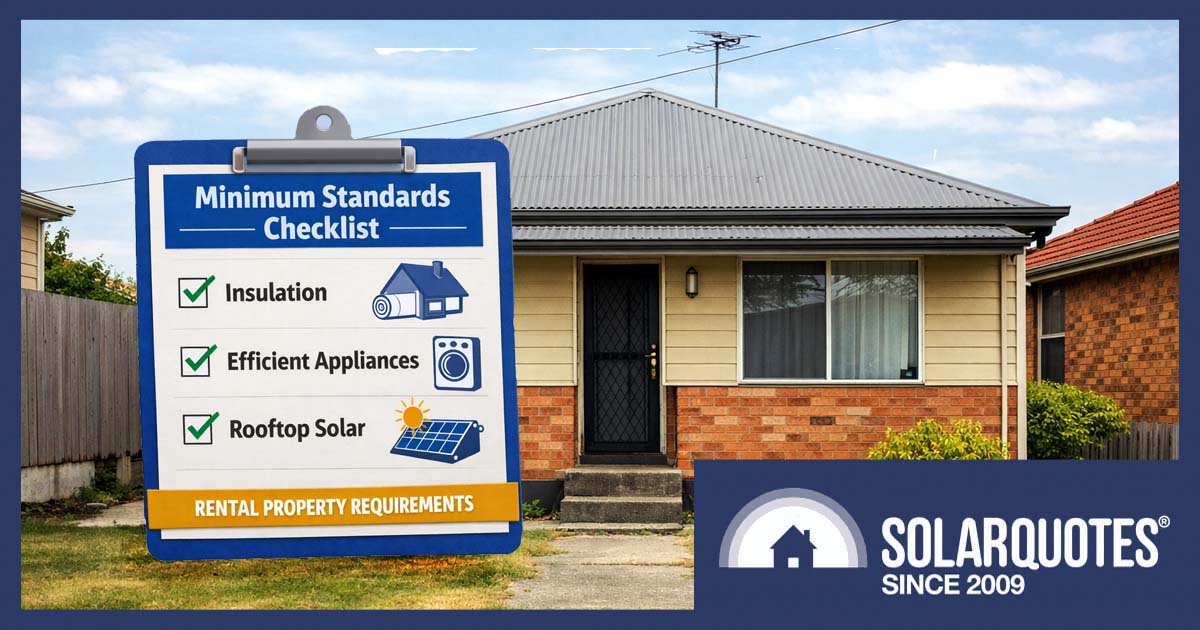

Australia has become a rooftop solar powerhouse, but millions of renters still lack the technologies that help homeowners cut their energy bills – a gap that mandatory minimum energy performance standards for rental properties could close, according to a new report.
The Institute for Energy Economics and Financial Analysis (IEEFA) estimates that most rental homes could reduce their energy costs by up to 50% through insulation, efficient appliances and rooftop solar panels, resulting in energy cost savings of approximately $107 billion by 2050.
Cumulative energy bill savings from rental property modernization, 2030-2050 (IEEFA modeling) Source: Institute for Energy Economics and Financial Analysis (IEEFA).
Why do tenants forego solar energy?
A long-standing structural problem in the rental market known as the “split incentive” means landlords pay for improvements while tenants pay energy bills.
This mismatch has resulted in rental properties consistently lagging behind homes when it comes to insulation, efficient appliances and rooftop solar panels.
“More than 30% of Australian households rent and are generally excluded from energy upgrades in their homes,” said Jay Gordon, energy finance analyst at IEEFA.
Solar incentives have limited impact
Governments have spent years offering rebates and subsidy-like programs to encourage landlords to upgrade their rental properties, but uptake has remained patchy.
According to IEEFA, this is not surprising as reducing upfront costs does not change who benefits from lower energy bills.
In short, carrots alone were not enough.
Is it time for the stick instead?
IEEFA argues that rebates and subsidies have failed to drive widespread modernization in rental housing.
Instead, governments may need to consider a stronger lever: minimum energy efficiency standards that require rental properties to meet basic performance levels.
Rather than relying on voluntary implementation, these standards would mandate improvements while allowing landlords flexibility in compliance.
These may include insulation, draftproofing, rooftop solar panels, batteries, or replacing gas and inefficient electric appliances with efficient electric alternatives.
Some jurisdictions have already begun implementing energy efficiency standards for rental housing. The ACT has adopted minimum insulation requirements for rental properties, while Victoria is introducing new standards covering measures such as heating, cooling, insulation and draftproofing. New South Wales is currently consulting on similar proposals.
Could tenants benefit even if the costs are passed on?
The analysis also addresses concerns that landlords could pass on modernization costs through higher rents.
It finds that if upgrades are financed over 15 years at typical investor loan rates, energy bill savings could still outweigh the repayment costs from day one.
At a national level, modeling shows a positive net present value of $24.8 billion by 2050 across the rental sector.
Costs vs. savings when modernizing rental properties as part of a 15-year financing model (IEEFA modeling) Source: Institute for Energy Economics and Financial Analysis (IEEFA).
Reducing energy costs for everyone
Beyond household savings, rental property modernization could also bring system-wide benefits.
In most regions, peak electricity demand would decrease in both summer and winter, while replacing gas appliances with efficient electric alternatives would significantly reduce gas consumption.
In Victoria, electrification could slightly increase peak winter demand, but this would be offset by a much larger reduction in gas use.
Requiring tenant solar upgrades
IEEFA says the findings highlight growing pressure on governments to find a more effective way to modernize Australia’s rental housing stock.
With renters making up a growing proportion of households, Australia’s rental energy gap is unlikely to be closed without minimum standards – a policy that moves from encouraging upgrades to requiring them, according to the analysis.
For more information on insulation, efficient appliances and solar roofs, see the SolarQuotes guide to energy efficiency.

Comments are closed.