

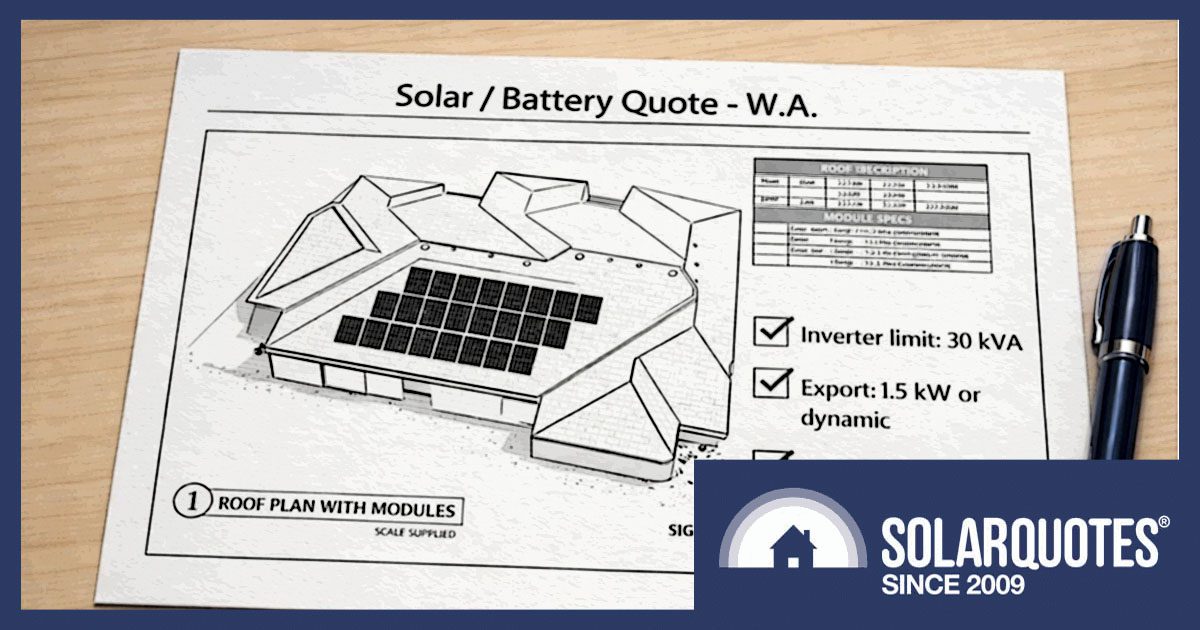

From May 1, 2026, new inverter rules will apply to solar and battery systems connected to WA’s main electricity grid managed by Western Power.
Your installer is responsible for ensuring that your system meets the technical requirements – that is his job. However, there are two things worth discussing with you: how your export limits are configured and whether your system has room for growth.
This guide will tell you what you need to pay attention to under the new rules. This is not general purchasing advice for solar systems, but specifically new design decisions that are important due to the new rules.
What changes are there for new installations?
The key change for new solar and battery systems in WA is that total inverter capacity will now be counted as a single total under a limit of 30kVA1. This influences the way systems are designed from the start, particularly when installing solar and battery inverters together or considering future expansion.
New systems must also meet updated export requirements, with either a fixed export limit of 1.5 kW or long-distance export control in accordance with network management requirements set by Western Power.
What to check before signing
System size
When you get quotes under the new rules, what matters is how your system’s total inverter capacity is counted. Under the total limit of 30 kVA, all inverter capacity on the property is added together, including solar and battery inverters.
In AC-coupled designs, solar and battery systems use separate inverters, so each contributes to the overall result.
For example, a 25kW solar inverter would only leave 5kW for the battery inverter. Charging a 25kWh battery would take 5 hours no matter how strong the sun was.
In a DC-coupled hybrid system, both functions run through a single inverter, so a 25 kW hybrid inverter system could enable 25 kW2 of solar panels and charge a 25 kWh battery in one hour.
Export restrictions
You should also confirm how export restrictions will be set up. Some systems operate with a fixed export cap of 1.5 kW, while others use remote export control, where exports can be adjusted by the network depending on system conditions.
Fixed exports are easier to configure and understand, but flexible exports export more and are therefore more lucrative as long as you receive a feed-in tariff.
System expansion
It’s also important to understand how much headroom your system leaves for future upgrades. Below the combined inverter limit of 30kVA, any additional inverter capacity – including a battery added later – will still count towards the same total allowance.
As mentioned, AC-coupled systems use separate inverters for solar and batteries, so adding a battery later uses more of the available capacity. If most of it has already been used, there may be little space left without replacing existing equipment.
Systems built around a single hybrid inverter do not require a second inverter for storage, which can facilitate future expansion within the same overall limit. However, you need to be confident that compatible batteries are still available at the time of purchase.
It is important to note that the limit does not apply per phase. If you are three phase you are still limited to 30kVA total.
Do existing solar systems need to be changed?
Existing systems are not affected unless they are modified or upgraded, but any change – including expanding battery capacity or increasing inverter size – will result in a reassessment under the updated 30kVA combined cycle inverter framework.
Avoid design headaches later
Making the design decisions at the quoting stage – inverter sizing, export settings, and accounting for future expansions – can help you avoid headaches later. Once installed under the 30kVA frame, changes may be limited and may require redesign rather than simple upgrades. That’s why the details in the initial offer are just as important as the equipment itself.
For more information on connection requirements and processes, visit the SolarQuotes WA Solar Connection Rules and Processes page.
For practical tips on evaluating solar deals, see our guide to obtaining and comparing solar deals.
Footnotes
- A note on kVA vs. kW
The nominal power of the inverters is specified in kW (kilowatts) in the data sheets and in kVA (kilovolt-amperes) in the network rules. For most residential solar and battery inverters, the two numbers are close enough to be treated as the same – a 10kW inverter counts as 10kVA below the 30kVA limit.
The difference lies in the power quality. kW measures the actual useful power delivered, while kVA measures the total electrical load on the network, including any inefficiencies caused by the interaction of current and voltage. With perfect power quality (power factor = 1), kW and kVA are identical. Modern grid-tied inverters generally need to operate close to a power factor of 1, so in practice the gap is small – but the grid rules use kVA because that is critical to grid capacity. ↩ - or more – battery inverters can be more oversized than solar inverters ↩

Comments are closed.