
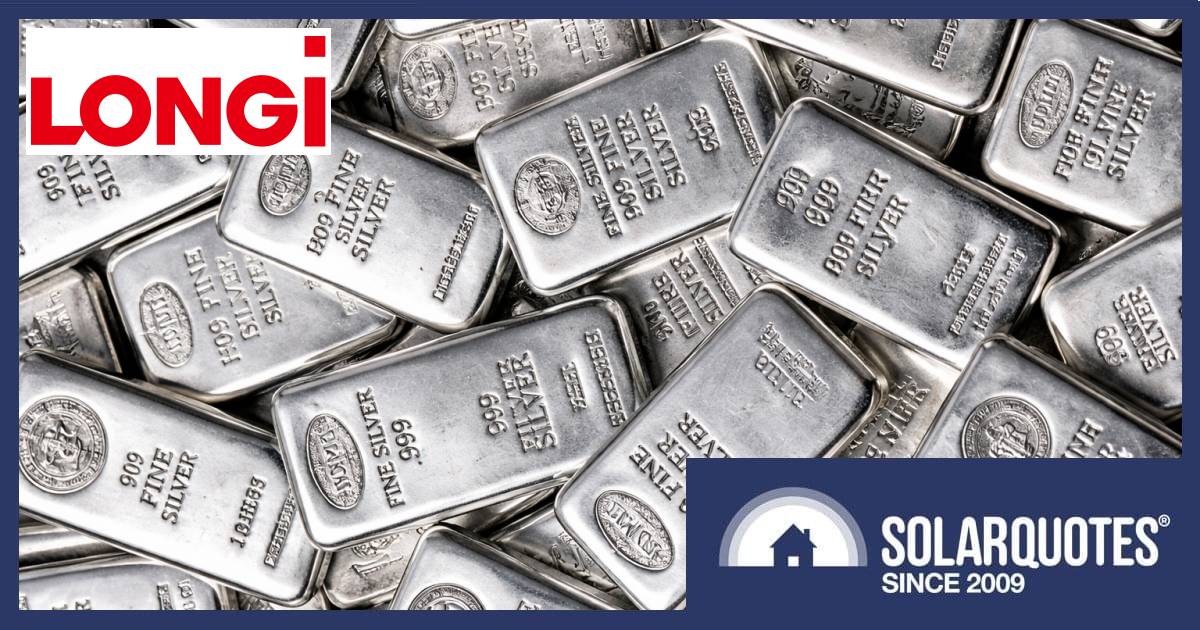

Chinese solar panel manufacturer Longi has reportedly decided to stop using silver in the production of its back-contact solar cells.
Why does Longi avoid silver?
Cost. Silver had been through a long period of time and the company, along with other manufacturers, had taken a serious hit.
Silver is primarily used in a highly conductive paste that forms “fingers,” “bus bars,” and back contacts on solar cells. And silver is expensive; currently about (AUD) $3.76 per gram. When I wrote about silver in solar panels last June, it cost $1.59 per gram – which was already high at the time.
According to various sources, about 20 grams of silver are used in a solar panel. Considering how cheap solar panels are right now (e.g. $120 for an inexpensive 440W panel – and that’s available at retail); The silver makes up a large part of the materials list.
Longi says it will turn to base metals as a replacement and will start using them in the second quarter of this year.
How much will Longi save?
By not using silver, a seemingly paltry 0.02 yuan per watt can be saved. This is equivalent to approximately 0.43 Australian cents at current exchange rates.
But think about the volume.
In 2024, Longi’s total shipments of back-contact (HPBC) modules, which the company says is easy to replace silver, reached more than 17 GW for the full year. So let’s apply the savings to these numbers:
17 GW = 17,000,000,000 watts
Savings per watt = 0.043c
Total Savings = (AUD) $73,100,000
It’s a significant amount.
Solar industry devours the world’s silver
According to the International Precious Metals Institute (IPMI), there was a demand for photovoltaic silver of 6,577 tons in 2024, and the solar industry accounted for 19% of global silver metal demand last year.
This demand could only grow. A study published just a few days ago estimates that supply may only meet 62-70% of silver demand in 2030; the authors predict 48,000-54,000 tons per year.
“The solar industry is expected to be the fastest growing source of silver demand, reaching 10,000-14,000 t/year (29-41% of supply),” the study said. “Despite slower growth, demand from competing sectors could rise to 38,000-40,000 t/year.”
But Longi isn’t the only manufacturer moving away from silver, and solid progress has been made in more efficient processes for recovering solar cell materials – so this scenario may not come to pass.
More news from Longi
In November 2025, we reported that Longi was entering the energy storage market through the acquisition of another company, Canadian company PotisEdge. Later in November, Longi officially announced a “collaboration” with the company.
“PotisEdge has maintained a safety record of zero thermal runaway incidents on more than 12 GWh of cumulative energy storage and power battery systems over the past decade,” Longi explained. “This will provide solid technical support for LONGi’s energy storage solutions.”
The company recently announced that it would focus on the domestic market as well as Europe, the USA and Australia.
It is not clear whether this will offer “Longi” energy storage solutions for private households, but PotisEdge already produces home batteries; and its ALOE Pro has been approved for use in Australia by the Clean Energy Council for some time.
In terms of financials, Longi’s operating income in the third quarter of 2025 was RMB 18.10 billion, down 9.78% year-on-year. Year-to-date sales were even worse; Decrease to RMB 50.91 billion, a decrease of 13.10% compared to the same period in 2024.
But the net loss had narrowed significantly (around 48% improvement compared to 9M 2024) and the operating cash flow for the first nine months turned positive.
The company sold 38.15 GW of wafers, 63.43 GW of cells and panels, and 14.48 GW of back-contact modules during the January-September period.
Longi was founded in 2000 and has been operating in Australia since 2016. In 2019, the company established a local limited liability company owned by the Longi Group.
The company’s panels are very popular with Australian households. This is largely thanks to their low price, although they are still a good solar panel option. Reviews of Longi solar panels by Australians here on SolarQuotes have been generally positive. The company has averaged 4.9 stars based on a total of 3,133 Australian customer reviews and 5.0 stars based on 1,081 reviews over the past 12 months.
Longi is currently listed as a SolarQuotes recommended solar panel brand.

Comments are closed.