

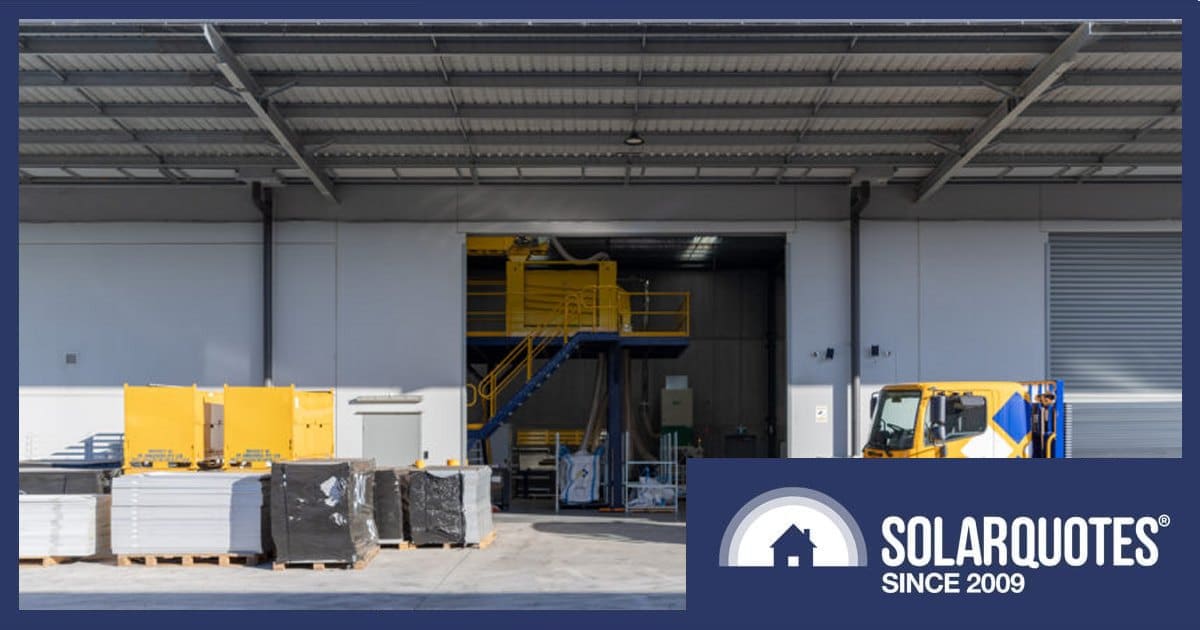

PV Industries’ new solar panel recycling facility at Bankstown Airport officially opened this week, supported by funding from the New South Wales Environment Protection Authority (EPA).
How many solar modules can the system recycle?
The EPA says the new Bankstown facility is expected to process up to 6,000 tonnes of solar panels per year; Every year, around 200,000 modules are kept out of the landfill. Processing each solar panel is fairly quick – under 90 seconds.
The numbers are a bit strange. At 6,000 tons/200,000 modules per year, each module weighs around 30 kilograms. However, most solar panels used for rooftop installations today weigh around 21 kilograms, and older, lower-power panels weigh even less. Larger, heavier modules may be used in commercial, industrial, and utility-scale PV systems, but most of the modules processed will likely come from residential sources in the system’s first years of operation.
And to process 200,000 panels annually, each taking about 90 seconds, a single processing line running 24 hours a day would take about 208 days; However, there may be more than one line at the Bankstown facility. Added: October 31st – In the comments below, Erik pointed out that the process involves several phases; Panels can go through different phases at the same time, significantly reducing the overall running time of the processing line.
How are the solar modules recycled?
After the panels have been transported to the facility:
- Frame, junction box and cable are separate.
- The glass is separated
- Metal recovery takes place; These include aluminum, glass, copper, silver and other valuable metals (silicon is not specifically mentioned).
- The materials are sent for reuse in various local manufacturing facilities.
PV Industries has developed two recycling technologies; the aptly named “Deframers” and “Deglassers”. According to the company, PV Industries is the first (and only) company to have an automated skimming machine in Australia. The EPA says PV Industries’ process can recover up to 90% of a solar panel’s weight.
Supported by Circular Solar Grants
In 2019, the New South Wales government launched a $10 million initiative called Circular Solar to reduce the amount of solar panels and battery systems ending up in landfill. In the first round of funding in 2021, PV Industries received $997,969 for:
- Develop safe handling and transportation procedures.
- Build a distributed collection and logistics network.
- Optimize high-quality processing approaches.
- Open up new end markets for waste glass.
Then in 2022, the company received $2,371,581 as part of Circular Solar’s second round to expand its processing technology, build the Bankstown facility and expand its collection and logistics network.
“The NSW EPA had the foresight in 2019 to establish the Circular Solar grant program, the first of its kind in Australia, to future-proof NSW’s solar recycling capacity,” said James Petesic, co-founder of PV Industries. “It allowed us at PV Industries, a local Sydney start-up, to bring our deframer and deglasser to life and ensure we are ready for the upcoming wave of retired solar panels.”
The EPA estimates solar panel waste in NSW could reach up to 63,000 tonnes per year by 2035.
“This new Bankstown facility is groundbreaking in its ability to accommodate large volumes of solar panel waste and open up new end markets for recovered glass and critical minerals,” NSW Environment Protection Authority (EPA) chief executive Tony Chappel said.
Six drop-off points have been set up across the state: in Bankstown, Dubbo, Maitland, Newcastle, Thornleigh and the Central Coast.
Progress of the National Solar Panel Stewardship Scheme
Australia’s annual solar panel waste volume is forecast to increase from 59,340 tonnes in 2025 to 91,165 tonnes in 2030; Most of this volume comes from residential solar systems.
While high quality solar panels should have a lifespan of 25 years; Not all of the modules installed here were of good quality – and when upgrading solar systems, modules can be thrown away long before their lifespan has expired. There have been various attempts to export still functional solar modules to developing countries, but this is becoming increasingly difficult due to the costs involved and falling prices for new solar modules.
A national stewardship system was an example of putting the matter at risk. As early as 2021, then-Federal Environment Minister Sussan Ley said that a nationwide draft stewardship system led by the solar industry must be completed by June 2022.
The Clean Energy Council (CEC) responded to this with allegations that it had been working on developing such a system, but that the federal government had “turned away” from the partnership. Ms Ley returned fire without specifically mentioning the CEC’s efforts, but said the proposals for such an effort lacked a “coherent, coordinated and sustainable approach”.
In September this year, a coalition of dozens of industry, community and business groups, as well as various local governments, called on the federal government to introduce a mandatory solar panel management system during this election cycle.
The New South Wales government says it is working with other states and territories to advance a national program and will present preliminary options to the Energy and Climate Change Ministerial Council early next year.

Comments are closed.