


Last week I was at Intersolar Europe in Munich and the first thing I can tell you is the size (watch my video above to get a real feel for the exhibition).
The exhibition area was eighteen halls in size1. All Energy in Melbourne, our largest solar conference, would include about one and a half of that. So about twelve times as big. It’s absolutely huge.
The second thing that stood out was the weather. It was 35 degrees Celsius outside, about fifteen degrees above the Munich average in June. Everyone was hot, hot, hot, and the air conditioning was clearly having problems. Fifteen degrees above average is crazy. Earth expressed its stance on global warming in the week that half of the solar industry was in town.
Panels are a commodity
Solar panels have become a commodity. Everyone goes to a booth and assumes they’re going to get something with 24 to 25 percent efficiency that converts light into electricity, and they’re right.
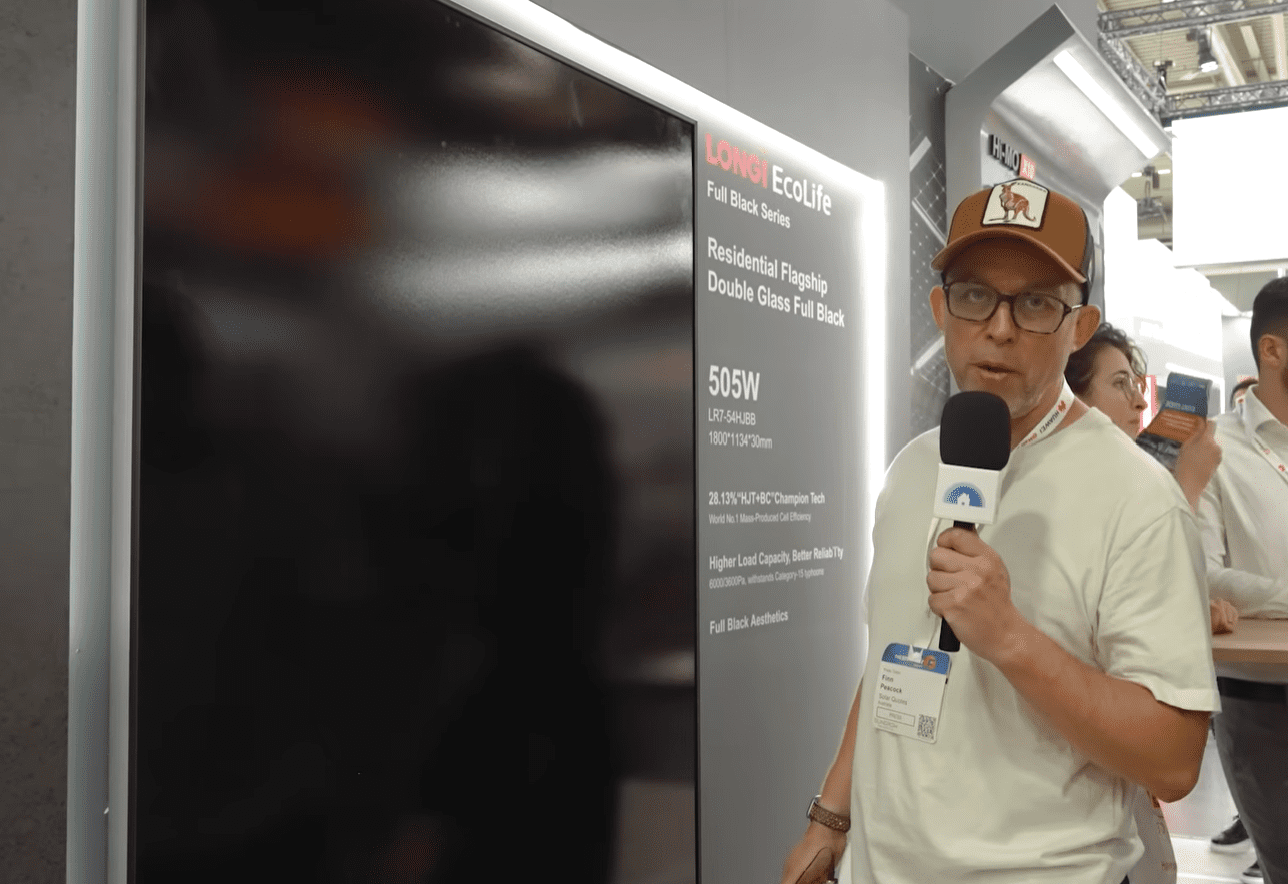
The star was probably LONGi’s EcoLife range. The 505-watt panels you can actually buy now are at the top of the mass production charts, with module efficiency of around 25 percent. LONGi also waved around new lab records at the same booth: a 28.13 percent back-contact cell and a 26.4 percent module. It’s worth keeping the record set and the shipping product separate in your head, but either way it’s incredible stuff2.
There were many large stands that disagreed on how to get there. AIKO and Tongwei were essentially arguing over whether the top con or the “bottom con” would win. AIKO believes that back contact, or bottom con if you will, is the way forward, with the best low light performance and efficiency. Tongwei had a large stand and promoted TOPCon.
Which one is right for you? Doesn’t matter. They are all excellent panels. Just buy a good product from a manufacturer that actually supports Australia and stop worrying about it.
With its EcoLife series, LONGi places great demands on cell efficiency.
How do you stand out by selling black rectangles?
When everyone is selling efficient black rectangles, the question becomes how to get noticed. The answer this year was building-integrated PV everywhere. Solar energy in the roof, ground, windows, fences, blinds and even pool furniture. Flexible panels, colored panels, every color under the sun, different shapes and patterns. Some of it looked great.
Conclusion: If you want a solar panel of any shape, color, pattern and flexibility, you can get it now.
Every major manufacturer on the SolarQuotes approval list has told me that Australia is important to them. Ulica Solar told me that the reason we pulled out of Australia years ago was because we expected Grade A equipment at Grade B prices. I’ve been thinking for a while about which retailers require this. My guess is that it was some of the big guys back then who were blowing up dirt cheap systems, some of which have since gone bust.
The building-integrated solar roof from the Lithuanian company SoliTek.
Balcony solar and balcony batteries
The other big highlight was the balcony solar system. Lightweight panels that you attach to a balcony railing with a cable tie and connect directly to a standard power outlet (GPO). They were absolutely everywhere. Legal in France and Germany, currently illegal in the UK, USA and of course Australia.
I met Jordan from Artisan Electric, a UK plumber and electrician with a popular YouTube channel, who told me that the UK government is relying on its standards body to make solar power on balconies legal. If successful, it will be an example that Australia could follow.
Speaking of balconies: balcony batteries were also everywhere. Imagine a mini version of a stackable home battery, about half the size, that sits on the ground, connects to a GPO, connects to your balcony’s solar array, and feeds in behind the meter to reduce your bill. Fantastic for renters and exactly what Australia needs. If Germany allows it and Germany has some of the strictest rules in the world in this area, I can’t understand why we can’t.
Hardwired batteries: everything from a single source
When it comes to proper hardwired home batteries, the entire industry has moved to all-in-one devices. Not just battery modules stacked on top of each other, but also the hybrid inverter integrated into the same stack. And now they’re going one step further and also integrating the gateway, switches and breakers that do the backup. The future of the hardwired home battery is an elegant stack on the wall. There is a lot of competition, which is great to see.
The architectures differ. Sigenergy installs a DC-DC converter in every module. SolarEdge runs everything off an 800-volt DC bus, which may make you nervous about every cable, but it results in a wonderfully flat efficiency curve. So even if you’re pulling a small 300 watt load overnight, efficiency will remain high, whereas something like the Sigenergy approach drops off at low nighttime power. SolarEdge assured me that their security systems make these 800 volt cables as safe as houses. That’s what they would say.
The other approach is Enphase, which runs everything from a 230-volt AC bus. Microinverter on the back of each panel, low voltage, AC. About the safest way you can do it.
Enphase finally has a battery worth buying
I was really pleased to see that Enphase had finally developed a stackable battery with decent energy density. The current third generation Enphase battery is so small in capacity, so physically large, and so expensive that I don’t think it’s viable. Honestly, I’m surprised they released it. Enphase owners have been looking for a good AC-coupled option, and the best choice right now is probably the FranklinWH.
The new one is the IQ Battery G5, and it looks well thought out. Enphase claims 1.9 times the energy density of the third-generation battery in a slim, stackable design. It is AC coupled and scales from 5 to 30 kWh in modular 5 kWh blocks, with each module having its own grid-forming microinverter. It runs single-phase or three-phase, uses something they call PowerMatch to get more usable energy and efficiency out of the package, and is designed to fit most existing Enphase solar and battery setups. Fifteen year guarantee. Europe will get it in the first quarter of 2027, Enphase tells me Australia will also get it early next year, and they promise it will be significantly cheaper than the current device.
Sorry, I didn’t take any decent photos of it, but you’ll see the G5 and every other battery I talk about in this post up close in our second Munich video coming next week.
So if you have Enphase on your roof or want to, you can finally stay in the ecosystem with a decent battery stack.
SolarEdge’s single inverter trick
SolarEdge had brought some interesting devices onto the market. Same 800 volt DC philosophy, but they’ve gone stackable like all the others, making only one stackable inverter model: twenty kilowatts, which you limit via software to the power you need (most likely because the DNSP rules have a cap of well under twenty kilowatts). One model size means a fixed production line configuration, which keeps costs down. And the battery stack looks really good, a big step up from the clunky ten-kilowatt-hour boxes currently available in Australia.
As a reminder, the all-in-one systems I saw came from FoxESS, Solis, GoodWe, Sigenergy, SolarEdge, EcoFlow, Anker, and Sungrow. The notable holdouts still making discrete inverters: Fronius and iStore.
Electric vehicle chargers: Stay on track
A disposable AC electric vehicle charger is, as our in-house installer Anthony Bennett likes to say, “a glorified extension cord”. Almost every manufacturer labeled their latest charger as “bi-directional ready,” pointing the finger at the cars that can’t yet perform proper bi-directional AC charging.
But you’d be crazy to buy an EV charger from a brand that doesn’t also supply your battery and hybrid inverter. The good news is that every decent battery manufacturer now makes their own charger. Sungrow only launched last year and I’m amazed it took the industry so long. Keep your inverter, battery and charger in one ecosystem and overall coordination through one app. This is how it should be done.
My favorite stand
My favorite booth was Enphase. Compared to the stands of the giant Chinese manufacturers, it was very modest and hidden at the other end of the fair. But I was happy to have found it – especially because I was so happy with this battery. Installation seems easy, and when combined with the uni- or bi-directional charger, the entire Enphase system is finally powerful for Australians.
This suits me well because I have thirty-five Enphase microinverters on my roof.
Tune in next week to see a second, in-depth video about the new battery technology at the show. Or better yet, subscribe to the SolarQuotes YouTube channel so you don’t miss it.
Footnotes
- For some reason I say 12 in the video – but it’s 18 ↩
- I incorrectly refer to the 28.13% in the video as panel efficiency and not cell efficiency – sorry ↩

Comments are closed.