

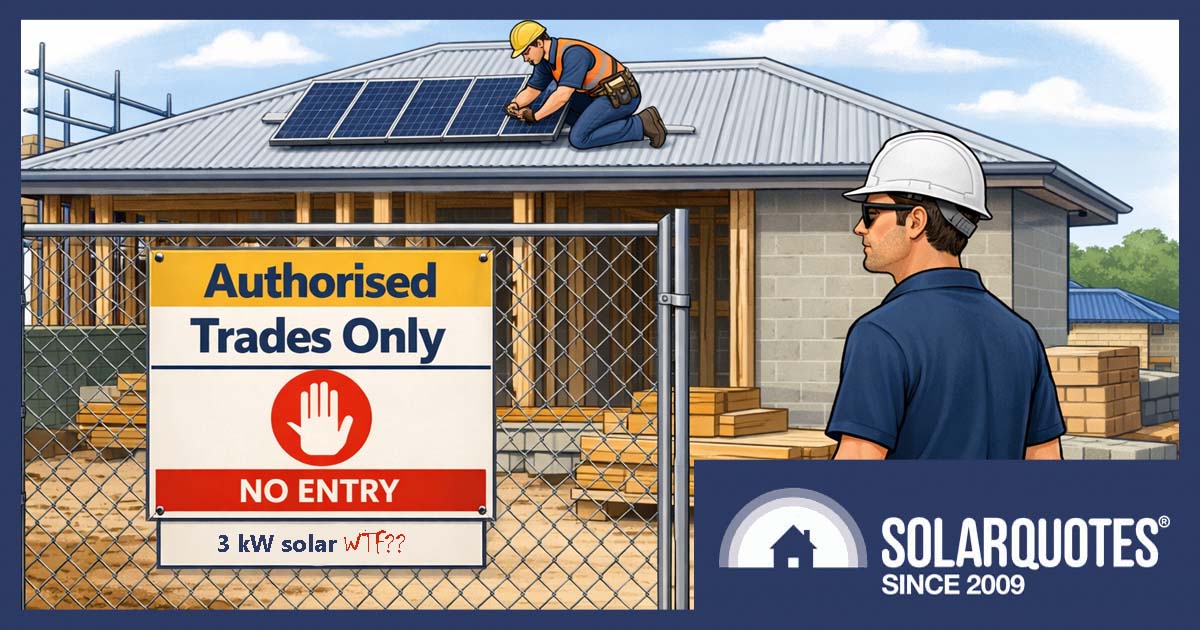

When you build a new home and assume solar can be sorted out later, many buyers don’t realize something until it’s too late: By the time a serious conversation occurs, the important decisions may already have been made.
Can you use your own solar installer for a new build?
Builders often bundle solar energy with everything else in the construction contract – flooring, lighting, appliances and air conditioning. But unlike most inclusions, solar energy can be tied to permits, energy ratings, building design and site access rules. That’s why homeowners who assume they can just “work it out later” sometimes find they have far less flexibility than expected.
As we mentioned earlier, hiring a solar installer before installing the drywall can save a lot of regret. In many cases, however, the real problem begins even earlier – before the contract is signed.
Sometimes. However, once a contract is signed, the contractor usually controls the location, trades and agreed scope of work.
Before signing, buyers may be able to:
- Remove solar from the contract
- negotiate different equipment
- Provide pre-wiring for future upgrades
- or organize your own installer
The correct pre-wiring for solar systems is much easier during the construction phase than later.
After signing it becomes much more difficult.
At this point, changes typically become contract changes. Building owners can also refuse access to third-party trades during construction for scheduling, liability and warranty reasons.
So while in the legal sense homeowners aren’t necessarily “forced” to hire a contractor’s installer, in practice the contractor often has control over what happens once construction begins.
This is the part that many people don’t realize.
Why do builders prefer their own solar systems?
Some homeowners assume that builders are pushing concentrated solar energy only because it’s profitable. And a margin can definitely be built into these systems.
But there is also a practical side.
Builders try to deliver a finished home on time, pass inspections and avoid delays. Solar takes care of roofing work, electrical structural work, certification documents and final approvals. Using a standard installer and system makes this process easier and more predictable.
The downside is that “builder solar” is often focused on completing the home efficiently rather than optimizing it for future electrification.
That’s one reason some homeowners are disappointed with small systems that quickly feel outdated.
Do new homes actually have to have solar energy?
There is a lot of confusion here.
Many homeowners are told that solar energy is mandatory as part of energy efficiency regulations, particularly in Victoria and New South Wales. But the reality is more nuanced.
New homes must meet the energy efficiency requirements of the National Construction Code (NCC). Depending on the condition and design, a solar system on the roof can help achieve the required output.
However, this does not automatically mean that every new home is legally required to have solar panels.
In many cases, solar energy is simply the cheapest or easiest way for a builder to meet the standard. Better insulation, more efficient heating and cooling, improved glazing or modernized hot water systems can also be used.
This is what homeowners sometimes hear:
“Solar is in demand”
if the more precise explanation could be:
“This design relies on solar energy to achieve the target rating.”
Why tiny “compliance systems” keep popping up
This also explains why some new homes end up with small solar systems – sometimes around 3kW – even if homeowners plan for full-scale electrification down the road.
If the system’s primary purpose is to achieve energy efficiency rating compliance, the builder’s priority is often simply to achieve compliance at the lowest cost.
This can result in homeowners having systems that technically meet the requirements, but do not fit the actual use of the home.
Later upgrades can also become more complicated than expected. A small inverter may need to be completely replaced, roof layouts may not be suitable for an expansion and homeowners may end up paying twice.
When planning solar power for a new building, you should do it right the first time.
The real problem is timing
Many homeowners assume that they can take care of the solar system later – replacing the installer, upgrading the system, or replacing the builder’s installation after handover.
But by then, the house design, permits and construction schedule may already be based on this original system.
For this reason, experienced installers often recommend seeking advice early in the construction process – ideally before the contract is signed and not after the roof has been completed.
Because as soon as construction begins, flexibility is quickly lost.
What should homeowners do?
The best time to seriously consider solar energy is before the construction contract is signed.
This does not necessarily mean that solar systems installed by the building owner will be rejected. Some systems may be completely sufficient. However, it does mean being clear about a few important things early on:
- What is included in the build and how much can be changed?
- Whether solar energy is required as part of the home’s energy efficiency requirements
- how future upgrades such as electric vehicle charging or battery charging were considered
Once construction begins, options tend to become limited. What seems like a simple change may result in a redesign of other parts of the build or a much more expensive option than expected.
Don’t assume that solar energy is something you can always “fix later.” Sometimes you can. Sometimes the build has already made the most important decisions.
If you’re planning a new home and want to know how solar energy fits into the design process before everything is finalized, it’s worth seeking advice from installers who regularly work with new builds.
For more information on how to properly use solar energy, see our detailed guide to solar panels.

Comments are closed.