

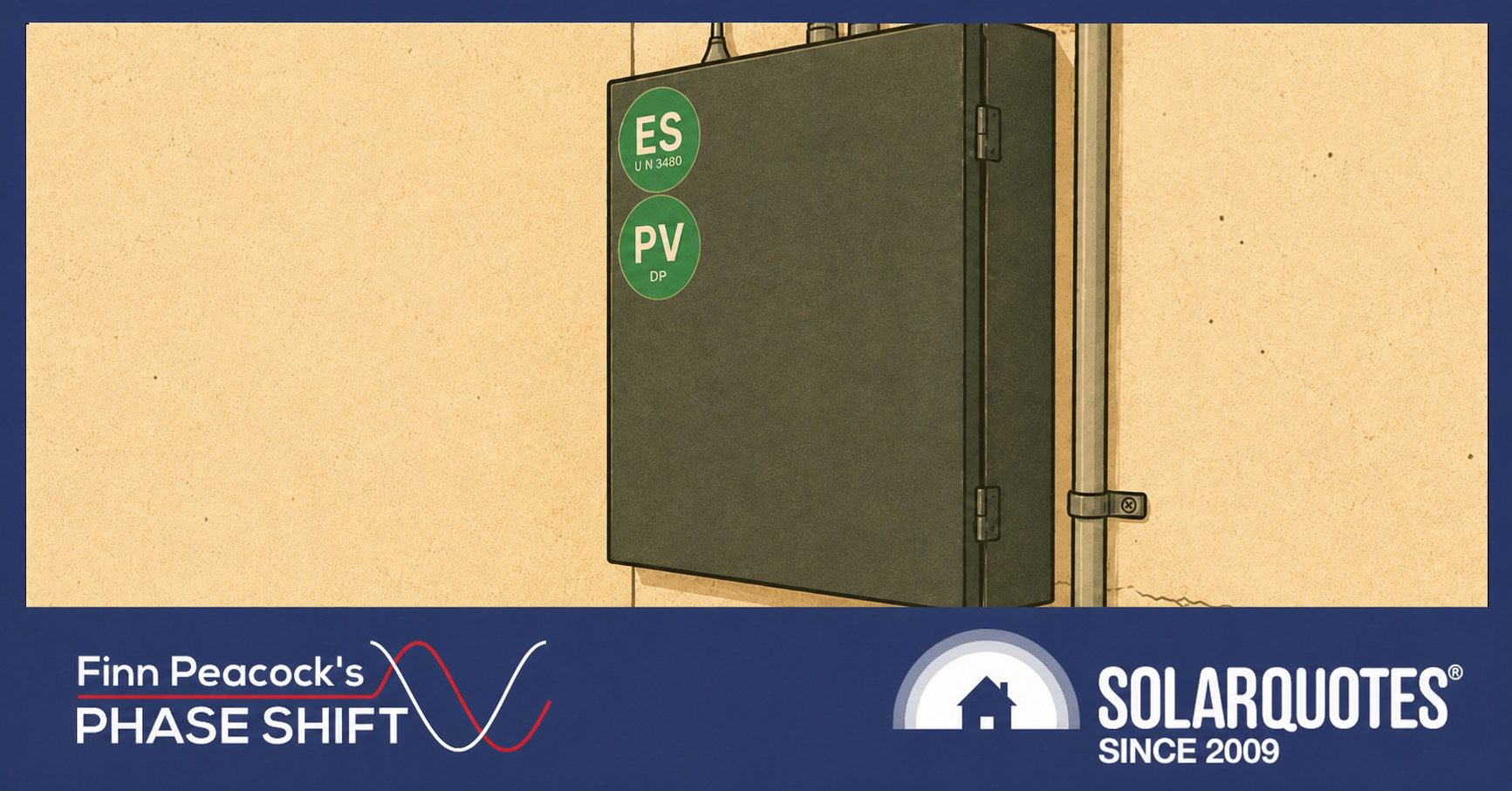

Your solar and battery system comes with numerous stickers. Warning signs, voltage signs, shutdown procedures, danger signs, restricted access notices. The standards (AS/NZS 5033 and AS/NZS 5139) require a small signage library.
But two of these stickers are more important than all the others combined.
They are both green. They are both circular. They are both reflective. And they’re both in the same place: your main electrical panel.
Sticker #1: The green “PV” sign
According to AS/NZS 5033:2021 Section 5.4, each solar installation must have a circular green reflective sign with a diameter of at least 100mm and the letters “PV” on or immediately adjacent to the main metering panel and main switchboard. It must be clearly visible to approaching rescue workers.
There is a subcode under “PV” that tells you what type of insulation the system has:
- Alternating current means low voltage DC (below 120V) with panels near the inverter. Lower risk. Think Enphase.
- SW means that there is a switch disconnector that can be flipped to disconnect.
- DP means that there is a separation point that can be pulled apart. This is the most common.
Sticker #2: The green “ES” sign
In accordance with AS/NZS 5139:2019 Section 7.3, each battery installation must have a circular green reflective sign with a diameter of at least 100mm and the letters “ES” (Energy Storage) on or immediately adjacent to the main metering panel and main switchboard. Here too, it is clearly visible to approaching rescue workers.
Under “ES” is the UN number for the battery chemistry:
- UN 3480 = Lithium-ion (including polymer)
- UN 3090 = lithium metal
- UN 2794 = Flooded lead acid
- UN 2800 = VRLA / AGM / Gel
- UN 3496 = Nickel metal hydride
This UN number refers to SAA/SNZ HB 76, the reference manual that first responders use to figure out how to handle hazardous materials. Different chemistry means different dangers: a lithium-ion thermal runaway is a completely different animal than a lead-acid electrolyte spill1.
Why these two are the most important labels in the job
Any other label required by these standards will give you detailed information about a hazard that you already know exists. The hazard signs, the arc flash stickers, the shutdown procedures, the toxic fumes warnings – they are all posted on or near the battery system or inverter. They’re useful, but they all assume you’ve already found the equipment and are standing in front of it.
The green PV and ES stickers are the only ones that indicate that the danger even exists.
They sit where everyone involved in electrical installation begins their work: at the switchboard.
The irony of doing it backwards
Here’s what I see too often: an installer covers the battery stack with all the labels in the kit, including the green ES sticker, then walks past the panel, packs up the van and drives away.
It’s like putting a “Beware of Dogs” sign in the doghouse.
The round green sticker should be attached to the electrical panel.
For Fox’s sake.
Please just stick them on the switchboard
These two green stickers will protect firefighters, future firefighters and homeowners for the next 20 years. It takes them two minutes to walk over and grab hold of the switchboard. That’s all anyone asks. Two stickers, two minutes, and every person who ever interacts with this switchboard will know what they’re dealing with before they have to find out the hard way.
Footnotes
- Speaking of electrolyte, a lithium-ion battery should never have an “electrolyte spill hazard” sticker on it, but they can be found everywhere. ↩

Comments are closed.