

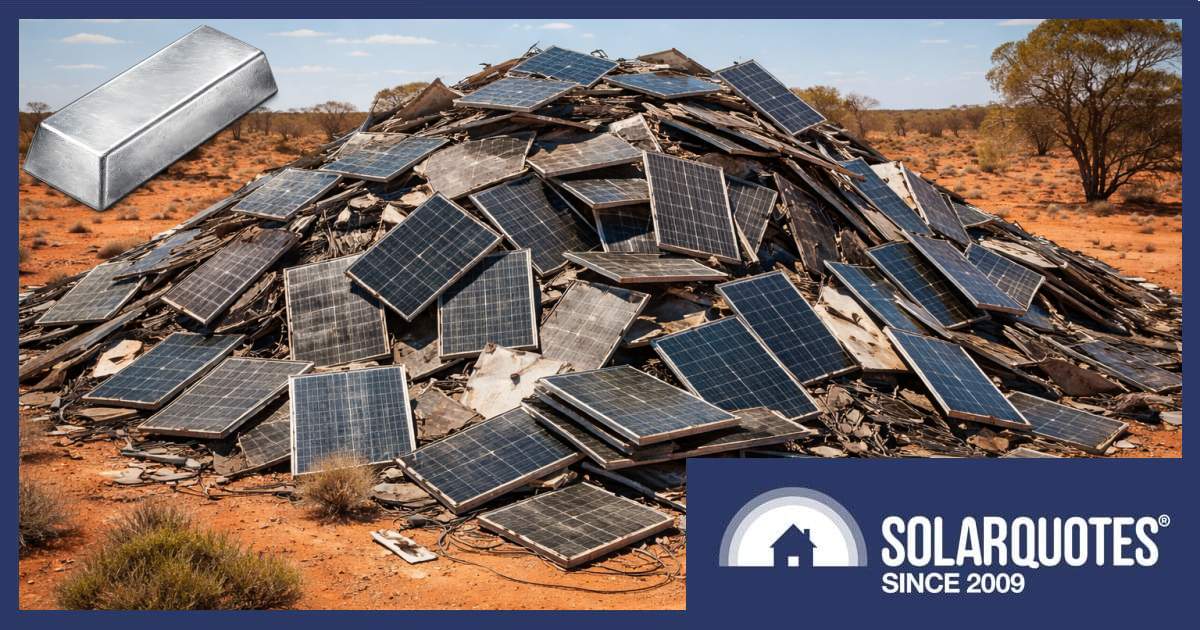

Researchers at the University of Newcastle say they have developed a highly efficient method for recovering high-quality silver from discarded solar panels.
What does the silver recovery process involve?
The new method, described as “fast, safe and highly effective,” uses a physical separation technique that combines:
- Comminution – the process of reducing the particle size of a material through mechanical means such as crushing, grinding and milling.
- Flotation – Use of water, air bubbles, and small amounts of standard reagents to float valuable metals to the surface while the waste materials sink.
The researchers say that more than 97 percent of the silver from a discarded solar panel can be recovered in just minutes using this technique, and that physical separation instead of chemical-intensive processes avoids significant environmental and safety risks.
Inspired by the mining industry
Foam flotation is already widely used in the mining industry1 to separate minerals and ores. But according to Associate Professor Mahshid Firouzi from the Center for Critical Minerals and Urban Mining (CRITIUM) at the University of Newcastle:
“…this is, to our knowledge, the first demonstration of foam flotation to recover metallic silver from recycled, milled solar panels – something that many experts in the field did not consider feasible.”
And based on various demand forecasts floating around, silver will be needed to make more solar panels sooner rather than later.
Perhaps.
A solar shift of silver?
But what if the solar industry – which accounted for 19% of global silver demand last year – starts turning its back on silver given the metal’s continued high cost? You don’t always have to commit to silver, because there are alternatives.
A few days ago we reported that Chinese solar panel manufacturer Longi would stop using silver in the production of its back-contact solar cells; Instead, “base metals” will be used as a replacement starting in the second quarter of this year.
Longi’s module shipments in 2025 experienced strong growth, reaching over 63 GW by the end of the third quarter of 2025. There are a hell of a lot of modules that suddenly no longer require silver and come from just one manufacturer. And according to reports, Longi isn’t the only solar panel manufacturer to forego it.
Combined with the advancement of recycling techniques, such as those developed by the University of Newcastle team, that enable economic extraction of valuable materials such as silver, the scenario of a recently published study suggesting that silver supplies could meet only 62-70% of global demand by 2030 may not materialize.
But when manufacturers throw away silver, it becomes a less valuable resource to recover from a solar panel, negatively impacting the economics of solar panel recycling.
How much silver is used in a solar panel?
About 20 grams. Since the spot silver price per gram in AUD is around $3.70 to $3.80 at the time of writing, that equates to a value of around $752 based on spot prices. And since solar panels are so cheap right now – just $120 for a 440-watt panel from a good brand – it’s no wonder manufacturers are really struggling.
The CRITIUM researchers explain:
“Old PV modules can contain high silver concentrations of 300 to 500 parts per million (ppm), which are comparable to and in some cases exceed the limit of primary silver mines.”
According to the Clean Energy Council, the total amount of discarded solar panels in Australia is expected to reach the 1 million tonne mark by 2035 and the total material value of this resource is expected to exceed $1 billion. And this resource valuation was based on silver prices that were much cheaper at the time.
The CRITIUM team doesn’t stop at silver
In addition to silver, the team is also working on recovering silicon from the cells of old solar modules.
“Silver was our first test case, but there are likely significant opportunities to apply crushing, flotation science and hydrodynamic techniques to unlock billions of dollars worth of other metals and minerals currently trapped in urban and mining waste,” Associate Professor Firouzi said. “We cannot afford for these valuable resources to go to waste.”
Australia’s solar recycling disgrace
While there is some movement at the station, as things currently stand only a small percentage of Australia’s decommissioned solar panels are being processed by recyclers.
It is more of a technical know-how problem. A joint statement signed by dozens of groups a few months ago said the blame was due to inaction by successive governments. However, another major concern is the cost of transporting the panels to a recycling facility, which can be higher than the cost of disposing of them at a local landfill. where permitted.
Footnotes
- And the paper recycling sector. ↩
- When I wrote generally on the topic of solar silver in 2024, the metal was worth A$1.59 per gram. Back in the 1970s the price was around 50 cents per gram. ↩

Comments are closed.