
Various creatures, including ants, may be able to find a home among or within the components of your solar power system. This is also why visual checks, if possible, and regular professional inspections of solar systems are so important.
How can little ants cause big solar problems?
Ants can cause problems in electrical circuits by causing short circuits (risk of electric shock and fire), tripping safety switches, and damaging wiring.
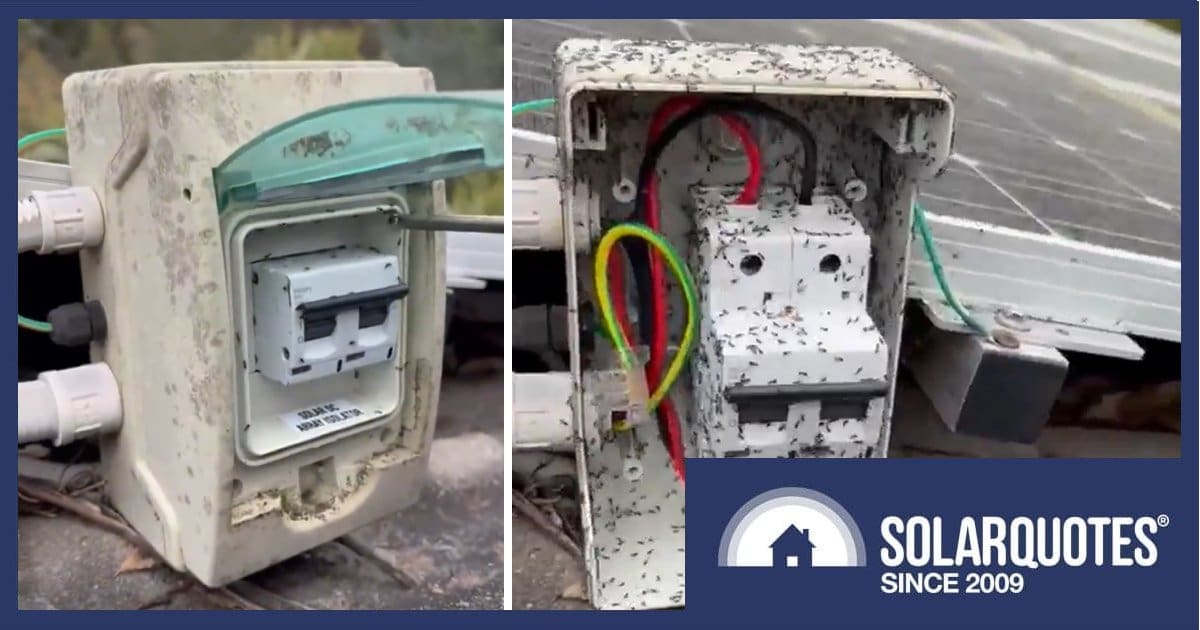
The Solar Repair Man carries out solar repairs and maintenance in Melbourne. During an inspection in Balwyn North, a DC circuit breaker on the roof was found to be infested with ants (pictured above).
The Solar Repairman commented on the find:
“We love sharing what we find out as we work because that’s the real side of solar maintenance; the stuff you don’t see until someone actually opens it. Ants, water, heat, corrosion, we run into it all.”
And it’s a good reminder of why regular solar inspections are so important, not just to keep everything running smoothly, but to prevent safety problems before they occur.”
How the ants came to set up their penthouse digs in the DC isolator is not clear. Although this does not appear to be a commonly reported problem, ants should not be able to get into the rooftop DC insulator as it is a safety device1 that must be sealed to prevent short circuits and system failure. more often due to water ingress than ants.
Ant intrusion indicates a poor quality or poorly installed/maintained insulator as the enclosure may have been improperly sealed or no longer properly sealed. Due to the condition of the external insulator housing, it may not have had the recommended cover to protect it from the elements. Or perhaps the ants wandered through the wiring and cables leading to the insulator through a place that wasn’t properly sealed.
Some ants are so small that they can penetrate almost anything, and some species of ants are believed to be attracted to magnetic fields created by electrical currents. like red fire ants – although they don’t appear to be present in this incident. An invasive species causing all sorts of problems in Queensland and some areas of northern New South Wales; Red fire ants are steadily marching south.
The warmth, protection and dry nesting sites provided by electrical devices are also attractive to ants, so keeping them away from solar panels and other devices such as air conditioners and light switches can be a challenge.
What other creatures can give solar owners headaches?
A few examples:
- Birds are a common culprit – they poop on solar panels, nest under them (or on inverters), and some species chew on wires. The accumulation of bird droppings under solar panels also poses a health risk if the roof is used to harvest rainwater.
- Rats and Mice – Nesting and Cable Chewing
- Wasps – they build nests under solar panels, creating hotspots that can damage the panels.
- Opossums – they chew on cables, mainly in the roof.
- Lizards – especially geckos – invade inverters, touching multiple points inside the device at once and frying both the lizard and the inverter.
How often should a solar system be checked?
Not only should you keep an eye on your inverter, battery and rooftop solar panels whenever you can (preferably without climbing on the roof – safety first), but regular professional inspections are a must as this could reveal things you can’t see. SolarQuotes currently recommends a full system inspection every five years.
In South Australia, the ACT and Victoria, Distributed Network Service Providers (DNSPs, also known as power distributors) *require* system inspections every five years; So if you haven’t had an inspection yet and the fifth year is approaching or has already passed, it’s time to organize one.
Recently, Energy Safe and Solar Victoria teamed up on a new campaign to encourage solar owners to have their systems checked regularly – every *2* years; That seems a bit ambitious considering the inspection costs around $330 to $500.
Whether you choose to have your solar installation done every two years or five years (or anywhere in between), SolarQuotes can help you arrange solar repairs and maintenance—including bird protection—from trusted professionals.
Footnotes
- The function of a rooftop DC isolator is to safely isolate direct current (DC) from the solar panels to the inverter in the event of an emergency such as a fire or during maintenance. Ironically, poorly installed/maintained rooftop DC isolators have been a leading cause of (still rare) rooftop solar fires in Australia. Most installers hate them, but they were a mandatory inclusion until late 2021, when a cutoff point became an acceptable alternative. ↩

Comments are closed.