

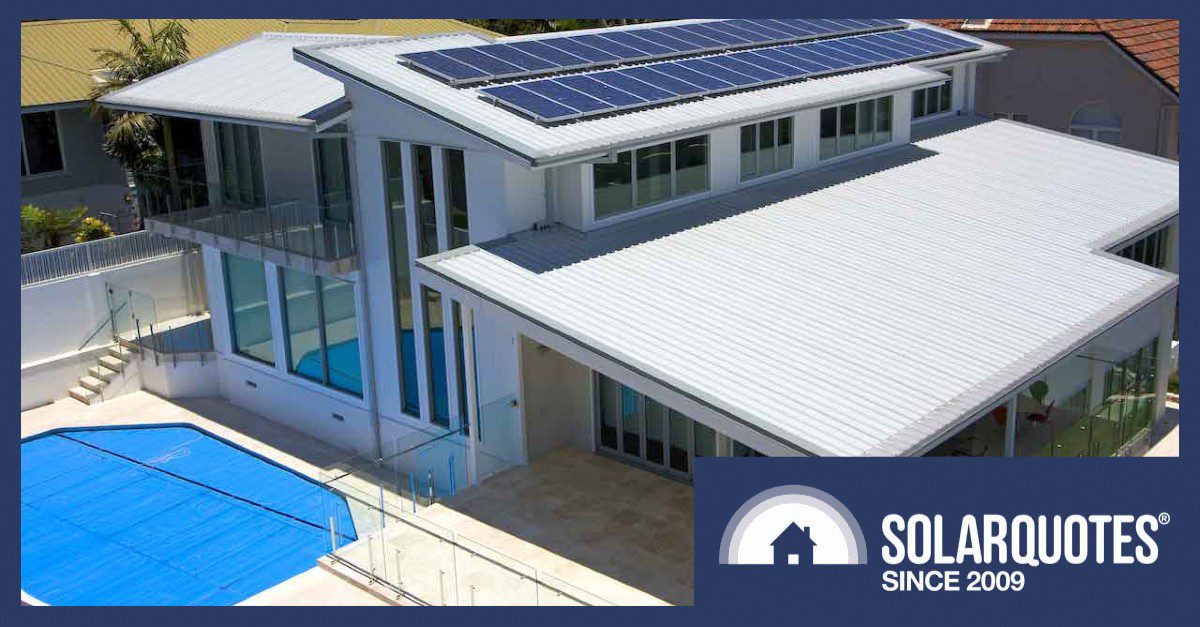

A house with a pool equipped with a solar system by Springers Solar.
Are swimming pools expensive to operate? In any case, a pool is basically a big hole that you have to run electricity into to keep it clean.
Read on as we explore some ways to minimize costs and maximize your solar efficiency.
How can you make pool pumps energy efficient?
If you check electrician forums regularly, you’ll notice that the topic of grounding around pools is always a lively topic. Basically, all metal must be secured within 1.2 meters of the water, but no one wants to see the anchors for fancy glass fencing panels strung together with green/yellow wires.
The peak demand for a large pool heater (refrigerant/heat pump) sometimes raises eyebrows, but what I find disappointing is that energy efficiency and controls don’t seem to get much mention.
The easiest way to control pool energy is with a simple timer. Combined with a “3 hours free” retail offer, you could make owning a pool relatively inexpensive if you have a really big pump.
Another option could be a CatchControl device, or a so-called sunshine circuit, which can be easily set up with your Fronius inverter, for example. It monitors your consumption and switches on the pump when there is enough solar power available. Bringing energy into the pool that would otherwise be exported.
There are two main burdens
First, there is filtering.
Every pool must be kept clean and the pump must ensure circulation of the pool water, although the filter must run for hours every day.
There may also be an electrically powered “salt water chlorinator,” loosely described as a low voltage DC battery charger. Pool water is disinfected by pumping it through an electrical grid in the plumbing, sometimes using ultraviolet light. This is variable but can be up to 3 kWh/day in summer.
Second, there is heating, which comes in two main forms.
- For passive solar heating using plastic pipes or rubber bands on an adjacent roof, there is often a second pump that runs most of the day to circulate the water when the sun is shining. This is often a lower load than the main pump.
- For active heating, some people waste money by burning gas, but the best method these days is to use a heat pump. Energy is still needed to pump water through the heat exchanger, but the main power consumer is the operation of the compressor in the cooling system.
PV solar and pool band on the right for low-quality heat.
What numbers are we talking about?
My inquiries state that an average 50,000 liter domestic swimming pool in Australia should be recirculated by filtration 1-3 times per day, with standard policy being at least one recirculation every 6-8 hours. However, for better filtration and sparkling clean swimming, 3-4 daily circulations are required to achieve over 95% filtration.
To circulate the entire volume of 50,000L; You need a pump that moves 104 liters per minute (L/min) to achieve circulation in 8 hours.
So that means at least a 0.75 to 1.2 kW pump that consumes 6 to 9.5 kWh/day. (e.g. $1.90-$2.85 at 30c/kWh) However, your pool may need twice the pumping capacity and a larger filter.
Guides advise us to run the pump for 5-7 hours per day for medium-sized pools like this (8-10 hours in summer, 4-6 hours in winter), split morning/evening for efficiency. Of course, adjustments need to be made depending on usage, climate and bathers.
Heating is also about numbers
Heating a 50,000 liter pool with a heat pump1 typically requires 1,500-4,000 kWh of electricity per heating season (3-6 months in South Australia), depending on desired temperature rise, ambient conditions and equipment efficiency.
In our 50kL example pool, a standard 15-20kW heat pump consumes 4-6kW of input power at a COP of 5-7, meaning it runs 4-8 hours daily to raise/maintain the temperature at 26-28°C. Daily consumption would be 20-48 kWh (e.g. $6-15/day at 30c/kWh).
Something tells me there was an architect involved on the left. The roof is bad for solar energy, but on the right we have a pool heater. And in the middle there is not only a roof system, but also a ground-level solar system for bonus points. Winner.
Passive heating is not always cheap
While the black plastic pool heater may use the same pump and heat effectively and for free while filtering the pool. As a solar installer, I often cursed the pool people. They would use the good rooftop real estate that we really needed for solar power.
Highlight in red – a rooftop pool heater that I coveted around 2013, when the parts alone for a 5kW solar system cost $8,700.
Dual-use roofing
With the advent of heat pumps for pool heating, we now have a good reason to remove outdated pool heating mats. Solar PV panels can generate electricity to heat your pool, and once that’s done, the electricity can be used for other purposes.
For those who already have a passive pool heater, I have seen at least two examples of creative solar system construction. On an iron roof, it’s not too difficult to push aside the rubber bands and install aluminum feet for traditional solar PV racks.
The fascinating result was a system that produces lower quality electricity AND heat. The company that did this collected an entire year’s worth of data to prove that they had only released 1°C of pool heat. It appears that despite the removal of direct radiant heat under the solar PV panels, it is still warm and keeping the cold breeze away from a pool heater tape helps maintain efficiency.
Given the warranty obligations, this is not an easy task for many installers, but as long as you are aware of the risk of leaks and are willing to forgo the rubber pipes if they do fail, then continuing to use a working pool heater sounds good to me.
Single-purpose solar
If you have a premium feed-in tariff, need to lay new cables in difficult terrain, or your local utility pole and line authority is running out of connection capacity, installing additional standalone solar systems may be an option. There are direct DC powered solar pool pumps available that do not require government approval or AC wiring.
One of my co-workers installed a DC solar pump years ago and couldn’t be happier. It’s no longer a burden that shows up on his electric bill, and since the pump basically runs whenever there’s sunlight, the pool is cleaner than ever when running on mains power, rationed by a timer.
Be aware of the gateway trap
It’s undoubtedly a beautiful problem to have, but setting up a sprawling property for solar power can prove difficult. In the example below, the house had a solar system and battery installed, but neither the electrician nor the customer knew that the pool was powered directly from the shed.
The electricity pylon to the shed is used for supply. The blue wires run from the retailer’s meter into the main electrical panel on the shed.
The bills didn’t go down because the pool was upstream, completely outside of the solar energy infrastructure. Consumption was measured via the dealer’s meter, but was invisible to solar monitoring as customer consumption measurement is done via a dedicated electrical panel.
It is often referred to as a smart meter or gateway and in addition to measuring, it also ensures isolation of the power grid in the event of an outage. This prevents you from powering network engineers and keeps your system from trying to run the entire network.
When the gateway moves from the house to the shed, it must be connected to a data cable via one of these paths
In this case, the gateway had to be moved so it could “see” the pool, which also means the house, pool and shed could have backup power during an outage. The tricky part was running a data cable across the garden to make it work.
Best advice? Do something now
We’ve been saying it for years: running a pool pump on grid power at 30, 40 or 50 cents per kWh is crazy when solar energy is so cheap. Even free electricity hours as part of a retail sale don’t help much unless you have a large pump and the wiring capacity to run it.
Footnotes
- Stay tuned, we’ll get into pool heat pumps soon, but to explain the concept, start here ↩

Comments are closed.